
How To Increase Your Focus
When we are facing extreme stress and uncertainty, our prefrontal cortex essentially goes offline. This is the part of our brain that is responsible for decision making, self-regulation, and higher-level thinking. It’s the part of our brain that helps us to focus and achieve our goals! Many studies have found that when we are facing major stressors, our concentration, memory and cognitive capacity suffer.
When this happens, the more primitive part of our brain takes over and starts running the show. This part of our brain is responsible for keeping us constantly wary and on the alert, looking for threats that might be coming our way so that we can immediate react to protect ourselves. When our primitive brain is in charge, it’s nearly impossible to focus on our work. Our minds constantly wander off and we feel compelled to constantly check on those aforementioned threats (and checking the news or Twitter is so easy!)
The primitive part of our brain is what keeps us alive when an immediate stressor arises (like a lion on the savannah or a bus careening by on the city streets). But when it’s long- term, chronic stress like we’re facing now, our primitive brains aren’t much help, and in fact, can make things worse. Our brain’s energy is being used up keeping us in a state of constant vigilance, instead of directed towards our tasks or goals.
Unfortunately, there’s nothing we can do about our biology. But we can learn strategies that help us to focus, how to carve out moments where our prefrontal cortex can come back online, and manage our environment to give us the best chance of success.

Give your brain a break.
Grab a piece of paper or your note-taking tool of choice. It’s time to give your brain a rest: it has been working really, really hard to keep track of every single open item, idea, to-do, delegated task, worry, home repair, and potential project that has come into your awareness over the past few months.
David Allen, the founder of the productivity system Getting Things Done, calls these ‘open loops’. Our brains experience constant low-level anxiety when we have open loops, which not only distracts us, but also makes it harder to focus. Instead of putting this enormous burden on your brain, document all of these open loops in one place. Consolidate all of your random sticky notes, bullet points in different apps, and mental reminders into this one spot, and continue to add to it over time.
Every day, choose the one rock you’ll tackle.
Either the night before or first thing in the morning, identify the single most important thing that you could do today: your rock.
There is always a way to prioritize, even when it seems impossible. Ask yourself which item on your list is the most critical or important. If it’s too big to get done all at once, break it down into more achievable pieces: what would a chunk of productive work on this project look like today?
Tackle the rock first thing in the morning.
If you don’t prioritize working on the rock first, you’ll get completely sucked in to working on the stones -- the small tasks that are often urgent or distracting, like answering emails or helping other people with their projects. Too often, the stones fill up the day, leaving no space left for what’s most important. When you prioritize the rock, you also reap a psychological benefit of feeling like you’re in control of your day. In turn, this often leads to a greater productivity upward cycle, where your first focus success leads to more successes throughout the day.
Set a timer.
Try to focus in micro-bursts. During the pandemic, I’ve gone from 45 minute focus blocks to 10 minutes. We have to trick our brain’s primitive side into focusing, and ten minutes is short and unintimidating enough. Set a timer for ten minutes and commit to focusing on your rock (with no distractions!) until it goes off. One of two things will happen. Either you’ll get into a state of flow, and when the timer goes off, you’ll be motivated to keep going. Other times, the timer will be a great relief. In those cases, take a short rejuvenation break and then set the timer again. Just ten minutes at a time will get you so much further than you think. This entire book was written using this strategy!
Take rejuvenation breaks.
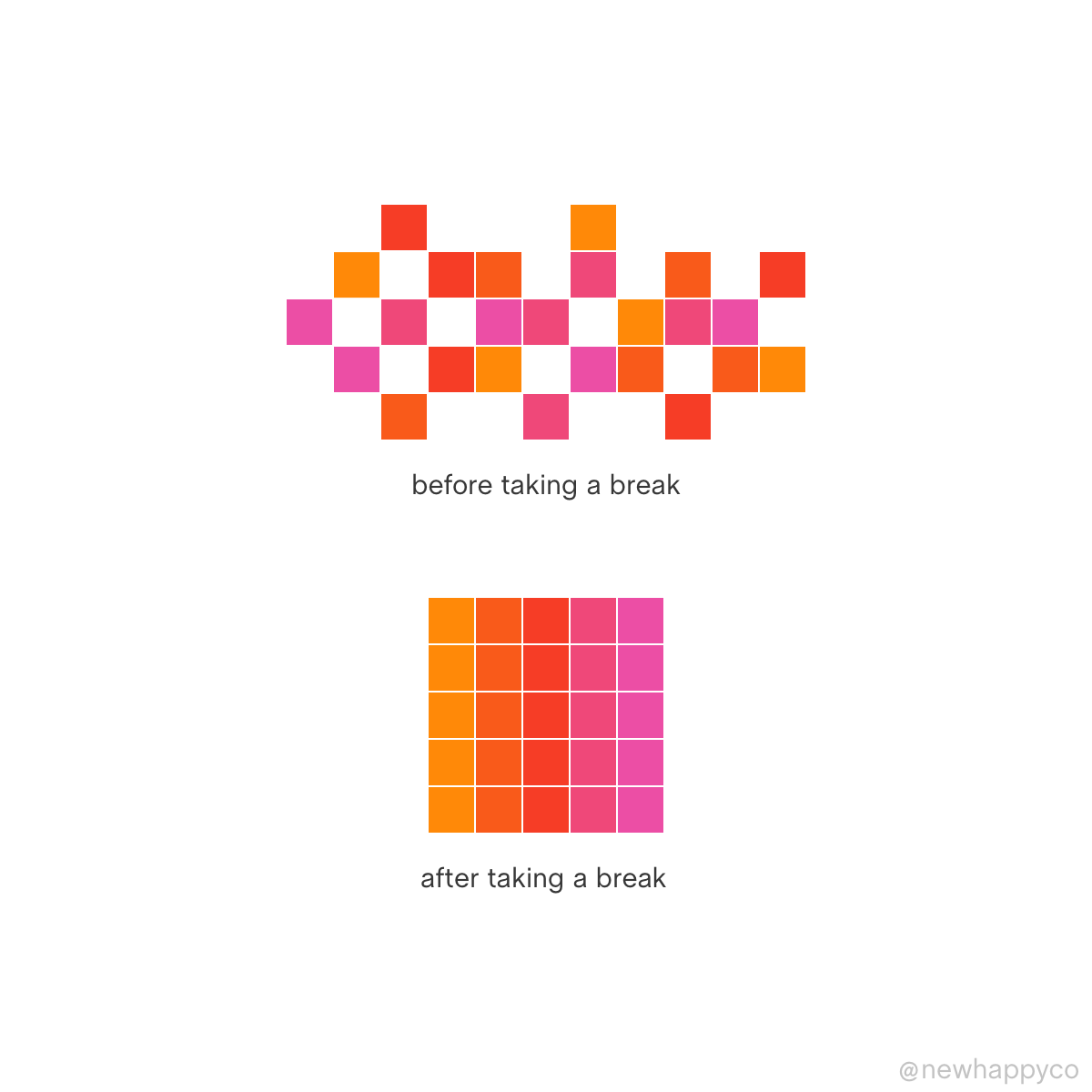
When you take a break, make it one that is soothing and supportive for your brain. Try not to immediately open social media or turn on the television on your breaks. Studies have found that these activities don’t truly replenish us -- instead, we are rejuvenated by sleep, movement, healthy food, meditation, and connection. A few ideas for your rejuvenation breaks: do one minute of stretching, eat a healthy snack with mindful awareness, write a gratitude note to someone who has helped you, or focus on your breath for a few minutes. All of these will set you up for better focus when you return to your work.
Make it a game with a friend or colleague.
Find a friend or colleague who can be a good accountability partner to you. Make a pact with them about what rocks you will accomplish in the next day or over the course of the week. Ask them to hold you accountable. You can do the same for them. Each morning, have a brief check-in to discuss how you’re doing, share what you’re struggling with, and brainstorm strategies to help one another.
Manage your environment.
Getting yourself into the right state of mind is only half the battle. The other is controlling your environment so that you are set up for success. The number one enemy of focus is a push notification. When you’re focusing on your rock, either put your phone in another room or on Do Not Disturb. One study found that the mere presence of a smartphone in the same room reduces your cognitive capacity!
Work with your family to define boundaries for when you need to focus. Whether it’s a sign, a shut door, or headphones, clarify the signals that help them to know not to bother you unless it’s crucial.
During rock work, tell your boss and colleagues that you’re logging off of your chat and email in order to focus for the next ninety minutes (or however long you’ve set aside). Log out of every program that might distract you. I use Freedom, an extension that blocks distracting websites, every time I need to write.
Even clearing off your working space can be incredibly helpful. Studies have found that cluttered spaces make it harder to focus and increase our stress levels.

Offer yourself compassion.
Don’t beat yourself up when you’re struggling to focus. This will only make it worse: it triggers even more uncertainty and anxiety, causing your brain to retreat further into protective, primitive mode. If you find yourself having a hard time focusing, either take a rejuvenation break or a moment to practice self-compassion. Remind yourself that this global pandemic is an incredibly challenging time, that you are doing the very best you can, and you are worthy of love and acceptance no matter what you ‘produce’ at work.

The Definitive Guide to Happiness
A groundbreaking new approach based on a decade’s worth of research and brought to life with beautiful artwork, New Happy shows you the proven path to happiness.
