

How To Be Grateful: A Simple Process For Practicing Gratitude
If you want to be a more grateful person, there are a few simple steps that you need to take. In this article, you will learn how to practice gratitude and why it matters.

If I was to ask you to, right now, name five things that are going wrong, you’d probably have an immediate answer:
You didn’t sleep well last night
You have a big deadline coming up
You have a lingering ache in your back
You’re frustrated with a colleague at work
You’re stressed about how to pay for a big upcoming expense
And if I was then to ask you to, right now, name five things that are going well, you probably wouldn’t have an immediate answer. You’d have to really stop and think about it. You might even struggle to come up with five things.
That’s because your brain has a negativity bias. At every moment, it is nudging you to pay more attention towards what is going wrong. From an evolutionary perspective, this is very smart: it protects you from danger. From a well-being perspective, this is very frustrating: it prevents you from seeing all of the good in your life.
Thanks to this bias, you often miss what’s going right—ignoring it, taking it for granted, or simply missing the opportunity to extract greater happiness from it. In fact, studies have found that most of us have more positive daily events than difficult ones, but because of this bias, it doesn’t feel this way.
That’s why one of the most important happiness skills is learning how to take control of your attention. That's what makes it possible to focus on what you want to see—not just what your brain wants you to see.
At any moment in your day, you can practice this skill. Here’s how:
At least once per day, pause whatever you’re doing.
Notice what your attention is focused on at that moment.
Consciously move your attention to something around that you that is positive, beautiful, or good. (Start small: the food you’re eating, a cup of tea, the sunshine.)
Keep your attention on it for at least 10-20 seconds. As you do, try to allow yourself to really appreciate its goodness and soak it in.
When you’re done, you might notice a change in your mood: you feel calmer, excited, or happier. And you might even notice that the world around you changes, too. For when we focus our attention on one thing that’s good, suddenly, we start to see so many other good things around us, too. Gratitude expands.

The Definitive Guide to Happiness
A groundbreaking new approach based on a decade’s worth of research and brought to life with beautiful artwork, New Happy shows you the proven path to happiness.
Read Next
How To Deal with Emotional Pain: A Simple Way To Manage Your Emotions
In this article, you will learn how to manage your emotional pain. We all feel difficult emotions from time to time. The best way to manage your painful emotions is to accept those emotions instead of pushing them away or ignoring them.
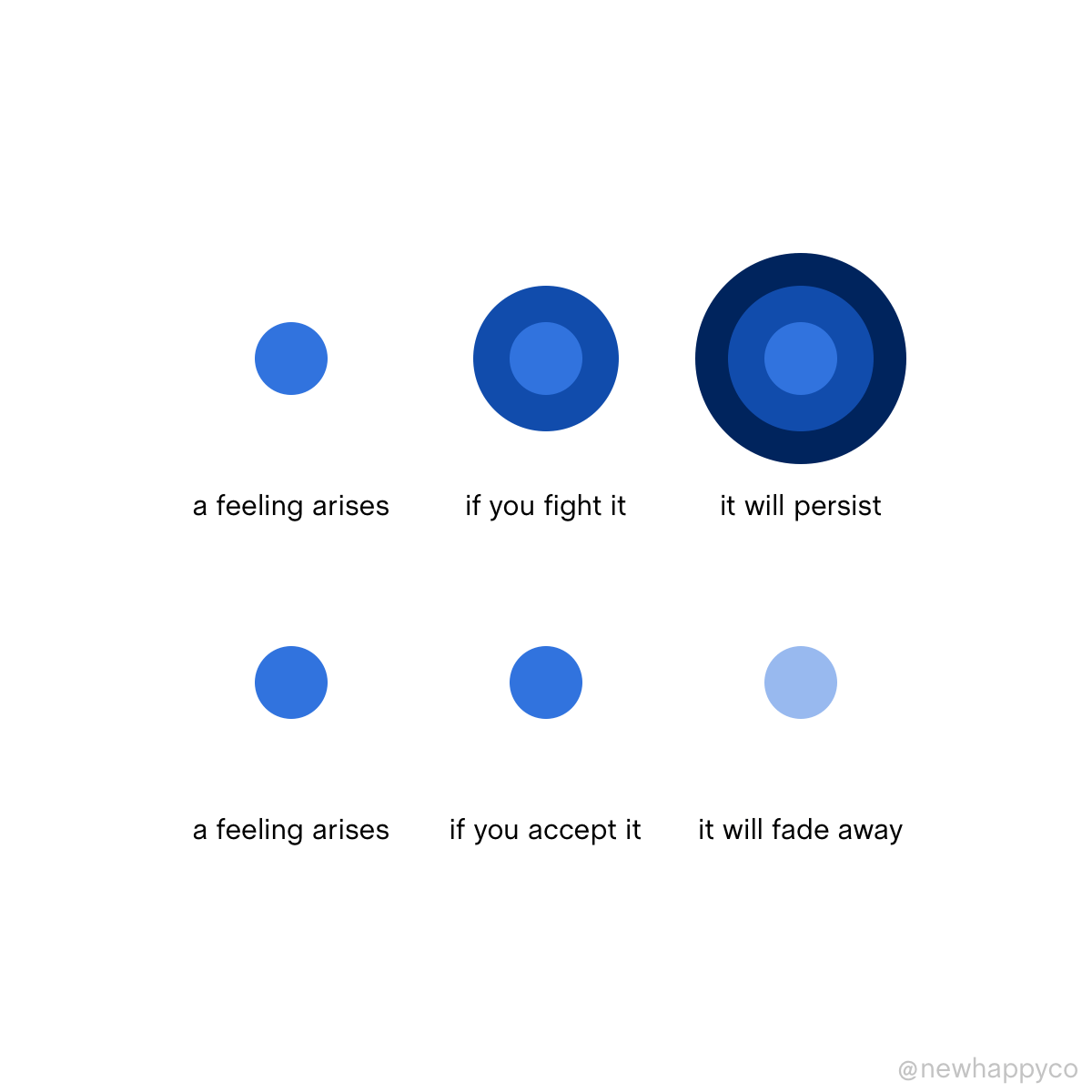
You're a human being. That means that you, like all other human beings, will experience painful and difficult emotions.
Instead of pushing these emotions away, viewing them as an indication that you're flawed or broken, try something new. Try to accept them, knowing that all they indicate is that you are a human being who is going through a particularly challenging moment.
Here's a powerful sentence to help you to do this:
"This is how it is, right now."
Say these words to yourself.
This pain is how it is... right now.
This sadness is how it is... right now.
This grief is how it is... right now.
In one sentence, we can accept whatever is happening in the moment. The magic of this sentence, though, is that it also reminds us that this moment will not last forever. Because that's another part of the human experience: that no matter how painful these moments are, they eventually do pass. And the sooner that we accept our emotions as they are, the faster that can happen.
The Definitive Guide to Happiness
A groundbreaking new approach based on a decade’s worth of research and brought to life with beautiful artwork, New Happy shows you the proven path to happiness.
Read Next
The Feelings Wheel
Most of us were not taught how to understand and manage our feelings. Your emotions are not something to be ashamed of. You don’t have to control your feelings. You don’t have to feel shame for them. Your feelings are something to learn from and work with.
Most of us were not taught how to understand and manage our feelings.
Your emotions are not something to be ashamed of. You don’t have to control your feelings. You don’t have to feel shame for them. Your feelings are something to learn from and work with.
To do this, you can use the Feelings Wheel, which is a tool invented by Dr. Gloria Wilcox to help people to understand and label their feelings.

You can download a free PDF of the New Happy Feelings Wheel, along with a helpful guide on how to use it and work with your emotions.
Here is how to use the feelings wheel.
Start at the center of the wheel and identify which of the emotion families you think that you are currently feeling.
Then, go out closer to the edges and see how specific you can get.
Which emotion is closest to what you are feeling right now? If you’re having trouble, try eliminating the ones that you know that you aren’t feeling.
Then, label it out loud. Say, “I am feeling…”
Give yourself a few moments to pause and sit with this feeling. Allow yourself to notice how it feels in your body, the thoughts you are thinking, and how it changes as you’re paying attention to it.
Extensive research has found that labeling your emotions is one of the best things you can do to improve your mental health. Studies from UCLA and other institutions have found that putting your feelings into words makes them easier to cope with. For example:
Rating your anger on a scale of 1-5 reduces your heart rate, a measure of distress.
Describing your emotions when dealing with a phobia increases your courage in facing it.
Adding a label to an emotion (like "that's sadness" or "this is fear") decreases the activity in your amygdala, which is where your fight-or-flight response comes from.
The more specific you can be, the better. Learning to label your emotions at a higher level of granularity is also shown to help you regulate and work with them more effectively.
Read Next
The Definitive Guide to Happiness
A groundbreaking new approach based on a decade’s worth of research and brought to life with beautiful artwork, New Happy shows you the proven path to happiness.
How To Manage Your Anger
In this guide, you will learn how to manage your anger, how to control your reactions, and what your anger can teach you.
Let’s talk about one of our most challenging emotions: anger. It's challenging in two ways: hard to feel and hard to manage.
I like to think of anger as a wave. There are different types of waves. Sometimes, it’s a small one that breaks quickly and without much fanfare—that’s irritation or annoyance. Sometimes, it’s an enormous wave that has grown and grown as it rushes towards the shore, where it finally breaks with enormous crashes and noise—that’s fury or rage.
It’s perfectly normal to have your own waves of anger. You are human and therefore you will feel angry sometimes. It is an emotion that serves a critical protective function, not only in safeguarding your own well-being but also the well-being of our society. With wisdom, anger can be transformed into a force for good, like when it is funneled toward the pursuit of justice and peace.
Unfortunately, our instinctive reactions to anger don’t often serve us: studies show that it hurts our well-being to repress anger, stew in it, or express it through unconstructive ways like venting and criticism. We need to learn a new way to work with it, and here's one way to do so.

Download this piece as a wallpaper, in dark and light mode
Catch it as it begins
Pay attention to early signs that you might be feeling anger.
Do you feel more alert, more judgmental, more separate from others?
Do you notice physical signs, like a racing heart or sweaty palms?
Do you start speaking more loudly, or shrinking down, or feeling overwhelmed?
As you start to notice the anger building within you, name it: this can help you tap into the wiser part of your brain and reduce the intensity of the emotion.
Pause, step away and breathe
If you can, step away from whatever has brought this feeling about.
You might say, “I’m going to take a few minutes break from this conversation until I’m feeling calmer,” or “I want to have a constructive meeting, so let’s revisit this in the future when we’re both in a good place.”
This pause can sometimes act like a wave-breaker, preventing the emotion from becoming bigger than necessary. At the very least, it gives you the chance to shift into responding instead of reacting.
Care for yourself until it passes
If you can’t physically distance yourself, focus on your breath. Using deliberate breathing practices can help you to navigate the intensity of the emotion.
If you can take some space, you might want to go for a walk, do a workout, journal about your feelings, or do something else that supports your well-being.
Reflect on what it has to teach you
Once the wave has passed, you have the opportunity to reflect on what brought the anger about and what lessons it contains for you.
Some questions you might ask yourself:
What sparked this anger? Be as specific as you can.
Did an external event trigger something within me? Often, we become angry because of deep-seated pains that happened long ago.
Do I need to express myself? Identify if there was a violation of your needs or boundaries that might need to be addressed.
Have I felt this anger before? Repeatedly experiencing chronic anger can lead to stress and health problems.
What's my responsibility? Identify any actions that you might need to take.
How could I prepare for this in the future? Decide on a plan of action for the next time that you encounter this challenge or trigger.
The Definitive Guide to Happiness
A groundbreaking new approach based on a decade’s worth of research and brought to life with beautiful artwork, New Happy shows you the proven path to happiness.
Read Next
How to Start Meditating And Why It Can Change Your Life
In this beginner’s guide to meditation, you will learn how to start practicing in as little as one minute per day, why meditation can change your life, the scientific research backing meditation, and some unique techniques that you can use if traditional meditation hasn’t helped you in the past.
In this beginner’s guide to meditation, you will learn how to start practicing in as little as one minute per day, why meditation can change your life, the scientific research backing meditation, and some unique techniques that you can use if traditional meditation hasn’t helped you in the past.
What Meditation Is
Meditation is a practice where you train your attention.
As defined by the meditation teacher, Jon Kabat-Zinn, “the awareness that arises through paying attention on purpose, in the present moment, and nonjudgmentally to the unfolding of experience moment by moment.”
Meditation is an ancient technique that has been practiced in multiple cultures and religions for thousands of years.
How To Start Meditating
The easiest way to start meditating is to set a timer on your phone for five minutes and then close your eyes.
Focus on your breath and take a few deep breaths.
Count, from 0 to 10, with each breath in and out. When you reach 10, start at the beginning again.
When you find yourself getting distracted, don’t beat yourself up. This is what our minds do: they get distracted.
Just begin counting again at 0. Keep going until the timer goes off.
The Scientific Benefits Of Meditation
Hundreds of studies have been done on mindfulness meditation. One recent meta-analysis found that, for healthcare workers, meditation:
Reduced stress
Reduced anxiety and depression anxiety
Reduced distress
Improved burnout
Increased empathy and compassion
Improved emotional intelligence
Improved emotional regulation
Correlations have been found between mindfulness and lower levels of depressive syndromes, higher levels of subjective well-being, and higher levels of eudaimonic well-being.
Mindfulness meditation offers individuals a chance to engage in a different relationship with their subjectivity by standing back and observing one’s experience of the world. In addition, it is theorized that this process, known as ‘reperceiving’, can lead to additional positive outcomes that include self-regulation; flexibility in cognition, behavior and emotions; clarification of values; and exposure
Why Meditation Can Make You Happier
Meditation helps you to train your attention, which is one of the most important elements of happiness, because it is the single most powerful resource that you possess.
Attention shapes our lives through filtering through all of the available existing information in the world and selects only a small portion of it, creating the world that we perceive to be ‘reality’.
In this moment, as you read the words on this page, your attention is focused on comprehending and understanding the text. You’re probably not, at this moment, thinking about the way that your pinky toe is pressing into the bottom of your shoe — but now you are. Now it is in your attention. You can’t help but notice it.
We can’t possibly pay attention to all of the things that are happening around us. There is so much going on at any one time: the sounds, the smells, the noises, the flickering light, the way our clothes feel, our latest emotional pain, the grocery store list, the nagging worry about a mole on your arm, that email you’ve been putting off. Our attention can only handle seven pieces of information at one time, give or take two (coincidentally, the average number of digits in a phone number!) From the nearly endless supply of stimuli, our attention must be selective.
There are two ways in which we select the objects of our attention: involuntarily and voluntarily. Involuntarily, we find our attention pulled by sounds, movements, interest or habit. Voluntarily, we choose to point our attention towards something that we have deemed personally meaningful or important to us, something that is important enough that we are willing to neglect the other stimuli and focus upon it.
William James, the founding father of psychology, argued that “effort of attention is the essential phenomenon of will.”
It is not easy to control our attention, because there is no shortage of stimuli out there in the world that beg for your attention and that hope to capitalize upon your lapses into involuntary selection. Any application that has a pop-up notification captures your involuntary attention.
But attention is also what allows us to pursue and experience well-being.
Attention allows us to engage in many positive choices, such as:
Choosing thoughts and battling unproductive ones, which is a core skill of resilience
Envisioning our future selves and lives in order to set goals and objectives
Choosing to execute upon strategies and implement habits or interventions, or override unhelpful / habitual responses
We have very little control over what happens to us and over the ultimate events of our external lives. While we can certainly increase the probability that good things will happen to us through activities like building strong relationships, finding a job that fits our strengths, exercising and eating healthy, and so on, it is an unfortunate truth of life that these are only valiant attempts at very best. Even those of us who live the most blessed, fortunate life imaginable will absolutely come to know and deeply experience suffering. While it might seem bleak to recognize that the only assurance in this life is that we cannot control the external world, it is in fact something that can set us free.
Your attention influences how you feel about your life, your self, and the happiness and joy that you get from both. Your happiness comes from cultivating inner harmony through the power of your attention.
The most expedient way to improve the quality of life is through taking responsibility for one’s own attention. Mindfulness and meditation is one way that you can do this. Through training your attention to observe your experiences, reframe your perspectives, and cultivate positive states, you will be able to increase your happiness and well-being.
Unique Meditation Techniques
If you have tried traditional meditation techniques and struggled to make them a habit, don’t worry: there are many other ways that you can integrate mindfulness practice into your daily life. Here are several non-traditional techniques that you might try.
Visual Meditation: We created this visual meditation that will help you to direct your attention towards loving yourself. As the words change on the screen, mentally say them to yourself.
Moving Meditation: Stretch your body and, as you do, focus on how it feels in each muscle.
Group Meditation: Many meditation teachers offer in-person and virtual gatherings to bring people together to practice.
Loving Kindness Meditation: This practice helps you to cultivate greater compassion for others.
Mindful Walk: Go on a walk and stay open to witnessing your surroundings, like paying extra attention to the sights, sounds, and smells.
Read Next
How To Stop Overthinking
Overthinking is a habit that involves dwelling on the same thoughts repeatedly. It can often turn into rumination, where you stay focused on negative emotions for a prolonged period of time, which can predict depression and anxiety as well as making symptoms worse.
Overthinking is a habit that involves dwelling on the same thoughts repeatedly. It can often turn into rumination, where you stay focused on negative emotions for a prolonged period of time, which can predict depression and anxiety as well as making symptoms worse.
Overthinking can be a difficult cycle to break out of. Here is a four-step exercise that will help you to do it.
Notice
Acknowledge that you're feeling overwhelmed, stressed, or agitated. That's completely okay. We all feel this way from time to time.
Acknowledge
Acknowledge what you're thinking. Remember: they're just thoughts. They don't define you, they are not more powerful than you, and they do not dictate what happens in your life. They are just fragments and representations of information bouncing around inside of your brain.
Extract
Take your thoughts out of your mind by writing them down.
It's often very difficult to find clarity on our thoughts when they're so busy bouncing around. Collect all of the thoughts and bring them outside of your brain and onto paper. Here, you can analyze them, organize them, challenge them, or clarify them.
Express
When you share your thoughts with another person. you once again are helping yourself to get the distance you need.
If you don't have someone to talk to that you trust, it can be worth exploring professional options or finding another way to process them outwardly, whether that's through movement, speaking out loud, or making a piece of art.
Read More
How To Be Kinder To Yourself
Many of us have been raised to accept that, to be successful, we have to be perfect. This perfectionism is often grounded in beliefs like, “I should never struggle to perform,” “I always have to get it right,” or, “I have to be the best at everything.” To be clear, those standards are impossible to meet — and often, detrimental to our success and well-being.
One Friday morning, early in my career, an email popped into my inbox. It was a client, inquiring about a weekly report. With a dawning sense of horror, I realized that I had completely forgotten to make and send it.
I quickly pulled the report together and sent it over, expressing how sorry I was for my mistake. My client couldn’t have been nicer about it. Despite their kindness, my internal voice couldn’t stop berating me: “How could you have made this mistake? What’s wrong with you? I knew you weren’t cut out for this job.”
Think back to the last time you made a mistake or had a setback at work. How did you respond? If, like me, you were extremely self-critical, ashamed, and stressed, or perceived yourself as a less worthy professional (or person), I want you to know that we’re not alone.
Why are we so hard on ourselves?
Many of us have been raised to accept that, to be successful, we have to be perfect. This perfectionism is often grounded in beliefs like, “I should never struggle to perform,” “I always have to get it right,” or, “I have to be the best at everything.” To be clear, those standards are impossible to meet — and often, detrimental to our success and well-being.
Studies show that perfectionism has significantly increased over the last two decades, to a dangerous effect. Young people hold unrealistic standards for themselves as, well as those around them. This perfectionism, in part, is driven by the societies we live in and the medias we regularly consume, many of which emphasize social comparison. Internalizing such idealism negatively affects everyone, but especially younger generations who are likely to be more depressed, more burned out, and less productive than the generations before them. The same research also highlights that perfectionism is a leading cause of increased anxiety and depression among young people in the U.S., the U.K., and Canada.
The truth is that mistakes, setbacks, and challenges are an inevitable part of our working lives. More importantly, they are necessary. There’s no way to grow, contribute, or make a difference without stumbling a little. Instead of meeting your mistakes with self-criticism, there’s a far better option: self-compassion.
What is self-compassion, and how does it work?
Self-compassion is a way of relating to yourself that is derived from Buddhist psychology. It was pioneered in academic research by professor Kristin Neff, who breaks self-compassion into three key components:
Self-kindness: Treating yourself with care and understanding.
Mindfulness: Accurately perceiving your thoughts, feelings, and experiences, without overidentifying with them.
A sense of common humanity: Recognizing that challenges are a part of the human experience.
Self-compassion has many benefits. It reduces feelings of anxiety and depression and improves your mental health. It makes you more resilient and adaptable. It helps you become more efficient and creative. Avoiding being harsh on yourself for every small misstep helps you overcome your fear of failure, admit mistakes, view them as a learning opportunity, and find new and creative solutions to move forward. In fact, a recent study also found that on days when employees were more self-compassionate, they made more progress on their goals and felt a greater sense of meaning at work.
That said, learning how to be kind to yourself takes time, effort, and practice. Here is a four-step strategy that I’ve developed to help me cut myself some slack and become more self-compassionate: CARE.
Here’s what it looks like:
C: Catch yourself being critical.
Often, our internal thoughts can feel like persistent background noise and be hard to turn off. One way to tune them down is to learn to listen to this noise with patience and care.
The next time you make a mistake, start observing the critical things you say to yourself. For example:
After noticing a typo in an email, you may say: “That was so irresponsible of me.”
After submitting your work, you may say: “That work wasn’t good enough.”
After speaking in a meeting, you may say: “That comment I made was so unnecessary.”
Bringing attention to these thoughts, in the moment that they come up, will help you identify them for what they are: just a critical or negative thought. When you notice yourself spiraling, stop and gently remind yourself: “That’s a very critical thought.”
While this action may seem small, it’s a significant first step. Only when we acknowledge the things that bother us can we begin to change them. So, think of this step as a critical intervention to learning how to treat yourself with more compassion.
A: Acknowledge your experiences.
When critical thoughts arise, they are typically born from bigger, underlying feelings. Delving deeper into what’s causing you to feel bad about yourself may be uncomfortable, so take your time.
There are several different challenges that we face at work. There are the big ones — like, losing a customer, not getting a promotion you had hoped for, or being laid off. Then, there are the smaller ones — a conflict with a coworker, a missed deadline, or forgetting to do something. In each of these moments, it’s completely normal to feel emotions like frustration, grief, anger, or sadness. While you might be tempted to suppress your emotions, a better strategy is to engage with them mindfully.
This practice is called emotional labeling and refers to identifying your emotions without judgment or reprimand. Instead, of just acknowledging that you’re being unkind to yourself, like you did in the previous step, here, take a step further to identify the emotions you’re feeling. The goal is to validate your experience and affirm your feelings, instead of running away from them.
For instance, if you missed a deadline, pay attention to your feelings. Are you angry? Sad? Upset? Frustrated? As you think more about this, say out loud to yourself: “I feel angry,” or, “I feel disappointed.”
Stating what you feel out loud quiets the amygdala and other limbic areas of the brain that are responsible for emotional processing. When you start paying attention to your emotions, it helps you see your feelings while making room for kindness.
R: Request your own compassion.
Now, ask yourself: “What would my most supportive friend say to me at this moment?”
It’s most likely that your friend will reassure you that you’re strong, intelligent, and capable, that you will bounce back from this challenge, and that you are loved, no matter what happens at work.
Visualize this situation, and try saying these words to yourself, with the same care and understanding. If it feels silly or awkward believing this, gain confidence from the fact that if your friend were to go through what you just experienced, you’d also use similar words for them.
Another way to request kindness from yourself is to create a simple mantra that grounds you in reality and releases you from the expectation of having to be perfect. Here are a few examples:
“I made a mistake today. But I’m not alone. Everyone stumbles and blunders.”
“Making a mistake makes me human. I’m allowed to err.”
“I’m letting go of the unkind expectation that I’m the only person in the world who can’t make mistakes.”
As you say these words to yourself, take deep breaths, put your hand on your heart, or close your eyes. Let yourself really feel this act of kindness, just like you would if it was coming from a loved one.
E: Explore the best next step
The CARE strategy is not only good for your well-being. It can also help you be creative and find new solutions to the problem you’re facing. That’s because compassion activates your parasympathetic nervous system, which reduces your stress and facilitates a more adaptive response to challenges. No matter your challenge, there is a way to move forward, and you’ll be far more likely to find it if you’re kind to yourself first.
Once you’ve offered yourself compassion, pause and, ask: “What’s one step I can take to improve this situation?”
For instance, if you forget to complete an important weekly task, think of ways to avoid that mistake in the future. You could, for instance, add a reminder or block an hour each week to work on the task. You can even send a reminder to all your team members if it’s a shared responsibility to ensure that the task is part of everyone’s agenda. Instead of taking on blame for your mistakes, use the incident as a lesson to find systemic and lasting solutions — something that everyone can benefit from.
. . .
If you’re used to criticizing yourself, self-compassion might feel foreign at first. Think of it as a muscle: the more you practice, the stronger it will become. Whenever you have a hard time extending yourself some grace, remember this: You deserve your own kindness.
This article was originally published at the Harvard Business Review.
Read More


A groundbreaking new approach based on a decade’s worth of research and brought to life with beautiful artwork, New Happy shows you the proven path to happiness.
Order today to receive exclusive bonus gifts that will help you to get even more out of the book.
