

How To Be More Confident
There’s a simple secret to confidence, according to research. In this article, you will learn how to start becoming a more confident person.

Here’s a fascinating paradox: we all want to be confident, yet the only way to do that is to make yourself vulnerable.
The only way to build confidence is through doing hard, scary, and uncomfortable things. As Eleanor Roosevelt so memorably described it, “You must do the thing that you think you cannot do.” While it’s terrifying, there’s also a big reward waiting for you: a deeper, stronger sense of confidence in yourself and what is possible in the future.
Stop saying, “I’m not confident enough to try that.”
Start saying, “I’m scared to try that, but I’m going to anyways, because I know it will make me confident.”
Read Next
How To Be Grateful: A Simple Process For Practicing Gratitude
If you want to be a more grateful person, there are a few simple steps that you need to take. In this article, you will learn how to practice gratitude and why it matters.

If I was to ask you to, right now, name five things that are going wrong, you’d probably have an immediate answer:
You didn’t sleep well last night
You have a big deadline coming up
You have a lingering ache in your back
You’re frustrated with a colleague at work
You’re stressed about how to pay for a big upcoming expense
And if I was then to ask you to, right now, name five things that are going well, you probably wouldn’t have an immediate answer. You’d have to really stop and think about it. You might even struggle to come up with five things.
That’s because your brain has a negativity bias. At every moment, it is nudging you to pay more attention towards what is going wrong. From an evolutionary perspective, this is very smart: it protects you from danger. From a well-being perspective, this is very frustrating: it prevents you from seeing all of the good in your life.
Thanks to this bias, you often miss what’s going right—ignoring it, taking it for granted, or simply missing the opportunity to extract greater happiness from it. In fact, studies have found that most of us have more positive daily events than difficult ones, but because of this bias, it doesn’t feel this way.
That’s why one of the most important happiness skills is learning how to take control of your attention. That's what makes it possible to focus on what you want to see—not just what your brain wants you to see.
At any moment in your day, you can practice this skill. Here’s how:
At least once per day, pause whatever you’re doing.
Notice what your attention is focused on at that moment.
Consciously move your attention to something around that you that is positive, beautiful, or good. (Start small: the food you’re eating, a cup of tea, the sunshine.)
Keep your attention on it for at least 10-20 seconds. As you do, try to allow yourself to really appreciate its goodness and soak it in.
When you’re done, you might notice a change in your mood: you feel calmer, excited, or happier. And you might even notice that the world around you changes, too. For when we focus our attention on one thing that’s good, suddenly, we start to see so many other good things around us, too. Gratitude expands.

The Definitive Guide to Happiness
A groundbreaking new approach based on a decade’s worth of research and brought to life with beautiful artwork, New Happy shows you the proven path to happiness.
Read Next
How To Deal with Emotional Pain: A Simple Way To Manage Your Emotions
In this article, you will learn how to manage your emotional pain. We all feel difficult emotions from time to time. The best way to manage your painful emotions is to accept those emotions instead of pushing them away or ignoring them.
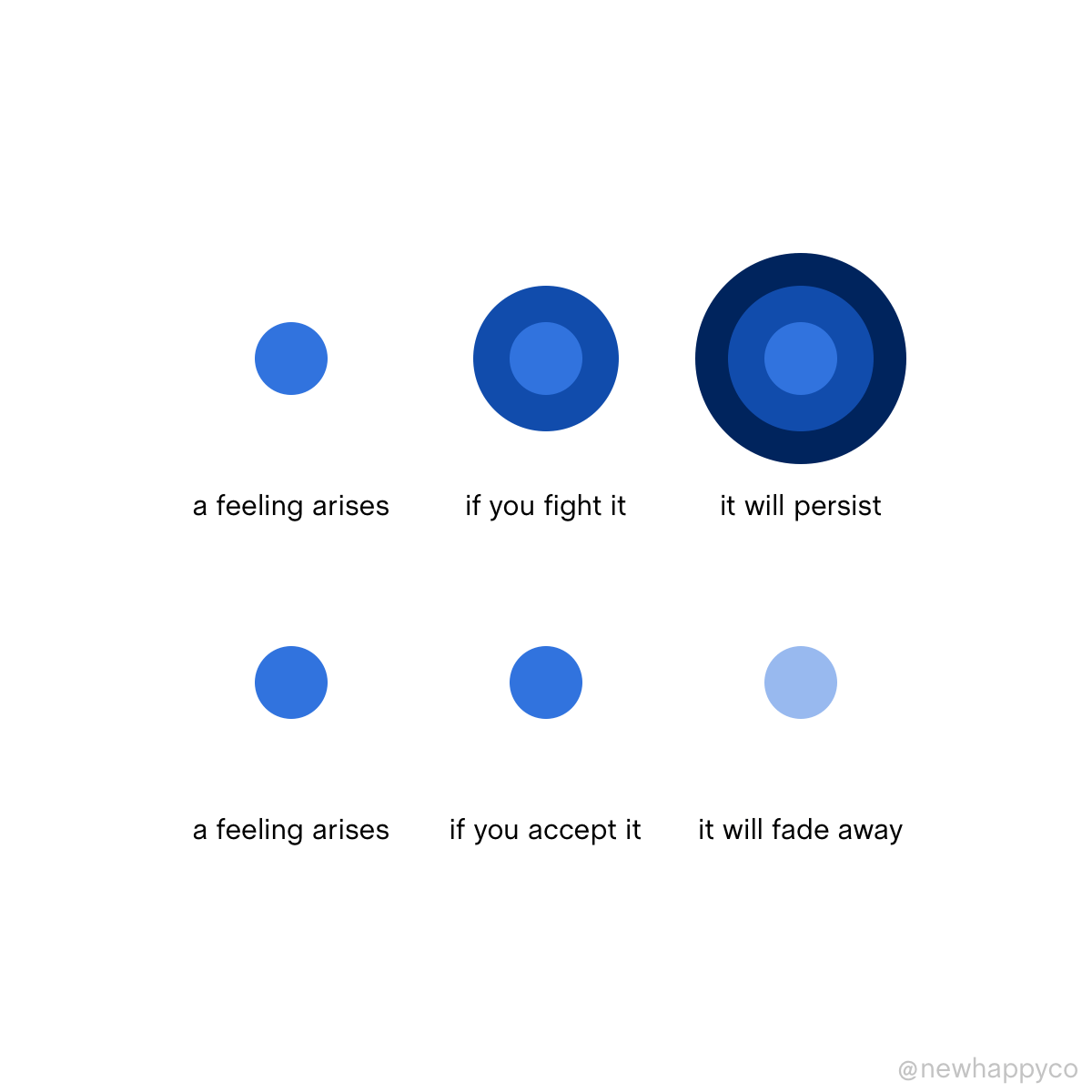
You're a human being. That means that you, like all other human beings, will experience painful and difficult emotions.
Instead of pushing these emotions away, viewing them as an indication that you're flawed or broken, try something new. Try to accept them, knowing that all they indicate is that you are a human being who is going through a particularly challenging moment.
Here's a powerful sentence to help you to do this:
"This is how it is, right now."
Say these words to yourself.
This pain is how it is... right now.
This sadness is how it is... right now.
This grief is how it is... right now.
In one sentence, we can accept whatever is happening in the moment. The magic of this sentence, though, is that it also reminds us that this moment will not last forever. Because that's another part of the human experience: that no matter how painful these moments are, they eventually do pass. And the sooner that we accept our emotions as they are, the faster that can happen.
The Definitive Guide to Happiness
A groundbreaking new approach based on a decade’s worth of research and brought to life with beautiful artwork, New Happy shows you the proven path to happiness.
Read Next
How To Increase Your Luck
According to professor Richard Wiseman at the University of Hertfordshire, you can make yourself a luckier person.
Science shows you can make yourself luckier.
Professor Richard Wiseman at the University of Hertfordshire is the leading academic researcher studying luck.
He’s spent his career seeking to understand the difference between lucky people and unlucky people, and discovered that there are very specific things that lucky people to do to increase their good fortune. Most importantly, he has also discovered that we can create more luck for ourselves through changing the way that we think and behave.
Increasing your luck isn’t about manifesting a vision or staying relentlessly positive or repeating what you want over and over again until it magically shows up. Just like we can consciously choose to put ourselves into a flow state, into a meditative state, or into a loving state, we can also put ourselves into a lucky state that then impacts our behaviors and thus, some outcomes.
In this article, you will learn the four ways to increase your luck.
Wiseman took these four principles and turned them into a ‘Luck School’, teaching unlucky people how to turn their fortunes around.
In total, 80% of people who attended said their luck had increased, and on average, they estimated their luck had increased by over 40%.
#1: Look for (and jump on) - opportunities
Lucky people have cultivated a particular skill in noticing and then taking advantage of opportunities. They tend to notice subtle opportunities and then find a way to take hold of them. Most people who describe themselves as lucky tend to be extroverted, optimistic, and most importantly, open-minded. By keeping a sense of curiosity alive and well at all times, you can see things that other people might miss. One of Wiseman’s studies found that lucky people smile twice as much and engage in more eye contact than unlucky people. That social interaction often leads to new opportunities for them.
One quick way to do this is to change up your daily routine and put yourself in new environments or new experiences. Another is to say yes to things that you would normally decline. As we get older, we tend to accumulate wisdom, which makes us feel as though we have the answers to life and that we know how it will unfold; by consciously adopting open-mindedness, we can try to stay more open to surprises and moments where our luck could change.
#2: Follow your gut
Lucky people listen to their gut feelings, and they act upon what they hear. They tune in and ask themselves how something feels, using any insights to inform their decisions.
They also consciously work to strengthen that ability by testing their hunches, learning from them, and finding ways to ‘hear it’ more effectively, like through meditating or creating mental space.
#3: Expect good things
Lucky people expect that life will be full of good things. Because of that belief, they tend to put themselves ‘out there’ more, as they believe that they will get what they want and aren’t ashamed to ask for it. This translates into raising your hand for opportunities, asking for things you want, and advocating for yourself, all of which have very positive outcomes.
(If you’re having trouble feeling this, remember that luck is also all about perspective. Someone out there believes that you are the luckiest person alive. If you are having trouble seeing that right now, put yourself in their shoes and imagine what it would be like to look at your life with that kind of awe and thankfulness.)
#4: Find ways to turn bad luck into good
And when inevitably, bad things happen to them, lucky people find a way to turn it into a positive thing. They tell themselves how much worse it could have been, try to control what they can of the situation, and practice their resilience skills to more effectively cope.
Wiseman’s experiments don’t stand alone as the only example of one’s mindset having extraordinary power: many studies have found that if you act as if something is true, it can bring about some of that truth. One famous experiment by Ellen Langer at Harvard brought eight 70 year-old-men from a nursing home into an environment designed to look exactly like their lives 20 years earlier. She instructed the men to pretend that they were 20 years younger. After a week, they showed improvements in strength, posture, memory, perception, cognition, hearing, and vision. Four independent volunteers looked at before & after experiment photos and rated those in the ‘after’ photos as an average of two years younger than in their ‘before’ photos. In her book, she writes that the men, some of whom had walked in to the study home needing canes, spent their last morning playing an impromptu touch football game on the front lawn.
There are obviously some very real limits to what your mindset can do; but your mindset can do an awful lot.
Pay Attention To Unseen Luck
One aspect of your luck that you can’t control is one of the most influential upon your life’s outcome: the circumstances that you are born into. In America, this is an extremely urgent and tragic problem. Studies have found that the family we are born into, our birth order, the neighborhoods we live in, the schools we attend, and our race and gender highly influence our outcomes in life. For example, one study found 74% of rich teenagers who score in the top quadrant in math earned a four year college degree; but only 41% of the poorest students with the same top math scores did so.
This ‘unseen luck’ promotes a horrible myth that only the worthy succeed. This myth is particularly exacerbated alongside of the American Dream’s argument that only hard work and talent are needed to get ahead, when in fact, there is so much that affects us that we do not have any conscious awareness of.
When we forget our fortune, our psychological biases make us start believing that everything good in our lives came about because of something special about us, rather than something special about our lucky birth circumstances. This then creates a feeling of superiority within people who have been the luckiest. For example, people from higher social economic classes have been found to be less attuned to other people’s suffering. Put together, you have a society where the born-lucky people can easily come to believe that they have earned their good fortune because of their talents, look down upon people who weren’t lucky and treat them with less compassion, and continue to perpetuate a myth that individual effort is the only thing that matters to success in life.
It’s essential that we practice gratitude for the external conditions that made our lives what they are. By doing so, we recognize that we are the beneficiaries of extreme good fortune and remember all of the things outside of us, that we had no control over that made it that way.
Proposing A Final Luck Principle
I want to add a final principle, a fifth, to Dr. Wiseman’s list: find a way to make others lucky.
Once you recognize how much good fortune has come your way, it becomes natural to want to find a way to increase the luck of others. Were you fortunate to attend an incredible school where you learned something special? Find a way to teach those things to others. Do you have a job that many people would dream of? Mentor others and help them to get there, too. There are millions of ways you can make other people lucky.
Your guidance, your time, your presence, your expertise, or your kindness might be the luckiest thing that someone else receives, something that changes their life forever.
What would it look like if you tried to live your life in a way that made others luckier? I suspect that it would make you feel even luckier yourself.
The Definitive Guide to Happiness
A groundbreaking new approach based on a decade’s worth of research and brought to life with beautiful artwork, New Happy shows you the proven path to happiness.
Read More
How To Become Wiser: 25 Questions To Ask Yourself
In this guide, you will learn what leads to wisdom and what does not. Get our list of 25 questions that will help you to become wiser.
You can’t become wiser by consuming wisdom. You become wiser through taking action.
Wisdom is something that develops with time and effort, through challenging yourself to look at situations from different perspectives in order to learn from them, examining your own behavior, and developing compassion for wider circles of beings.
Written wisdom can give you powerful and inspiring ideas about how to direct your action, serving like a North Star. But there’s no way to skip the work of becoming wiser. We need to grapple with these ideas, test and try them in our lives, and internalize them through trial and error. As Seneca said, “No man was ever wise by chance.” It’s a relatively rare attribute for a reason!

Here are 25 questions you can use to help you develop your own wisdom. Use them to pause, reflect, realign, and help you take the next, wisest action.
Seeking perspective
What’s another way to look at this?
What assumptions am I making right now?
How would an objective observer describe what happened?
Who is this benefitting and who is it hurting?
What would my wisest mentor advise me to think, ask, or do at this moment?
If everyone made this choice, how would it affect the world?
What are the ripple effects of this choice in the immediate moment, short-term and long-term?
Examining yourself
What would I do in this moment if someone was watching me?
What can I learn from this situation?
Where am I failing to uphold my values?
Is this choice helping me move closer to my values or further away from them?
How are my personal experiences, biases, fears, and goals affecting the way I am looking at this?
Are my words and my actions aligning (living with integrity)? If not, what do I need to do differently?
What is happening within me that I might be projecting onto another person or this situation?
How are my strengths and weaknesses affecting my response in this moment?
How have I contributed to this situation?
Developing compassion
What do I need in order to see this situation from a wiser perspective?
What would constitute a good outcome for everyone involved?
What’s the most caring interpretation of this person’s actions?
What needs is this person trying to fulfill right now?
How might this person or group be suffering right now?
What’s the choice that benefits the greater good?
If I’m judging someone, have I behaved similarly before? What was going on for me at that moment?
Is the choice I’m making leading to more love and compassion in the world?
Read Next
How To Stop Living On Autopilot
It’s easy to live on autopilot and go along with the cultural conditioning of our Old Happy world. But at any moment, we can pause and take a step back, getting curious about how we want to live instead. And then start. Right here — in this moment, with one different choice.
It’s easy to live on autopilot and go along with the cultural conditioning of our Old Happy world:
Keep pushing harder and harder.
Keep striving towards an ever-eternal future destination.
Keep denying your unique gifts.
Keep ignoring our interconnectedness.
But at any moment, we can pause and take a step back, getting curious about how we want to live instead. And then start. Right here — in this moment, with one different choice.
Here are a few favorite questions to help you show up for your life in a more authentic, more joyful way. Choose one, and give yourself a moment or two to see what answers come up within you.
What is happening in this present moment that I can embrace?
What does my true self yearn to do?
What inside me needs to be expressed?
When in my life have I felt the most joy?
When and where have I lost a part of my true self? What’s one step I can take to reclaim it?
What do I need to support myself?
What am I feeling right now?
What experiences have made me feel connected to the world and humanity? How can I have more of those?
Who needs me?
How can I help others?
What one action would make me feel like I am living with presence today?
Living with presence is, ultimately, about creating a life that feels like you: a life that brings you the joy you deserve, a life that enriches our collective world.
Read Next
How To Make Better Decisions
Every day, you make thousands of decisions. Over time, those decisions end up shaping the course of your life. Here’s the problem: you’re not a rational person. No one is.
Every day, you make thousands of decisions. Over time, those decisions end up shaping the course of your life.
Here’s the problem: you’re not a rational person. No one is.
A substantial body of research has found that human beings make irrational decisions, thanks to a number of persistent cognitive biases that shape the way we evaluate our options and make choices. Unfortunately, because of the way we are wired, it’s hard to make good decisions that make us happy and easy to make bad decisions that make us unhappy.
Here is the good news: there is a specific set of tools, backed by science, that you can use to make better choices every day.
I will break these tools into two groups:
Stop making stupid decisions by avoiding cognitive biases
Make wiser decisions using mental models
How To Stop Making Stupid Decisions
The legendary investor Charlie Munger, vice chairman of Berkshire Hathaway, once said:
“It is remarkable how much long-term advantage people like us have gotten by trying to be consistently not stupid, instead of trying to be very intelligent.”
Our cognitive biases are what lead to stupid decisions. These biases are like automatic mental shortcuts that your brain has developed in order to make it easier to cope in daily life.
The leading researcher in the field, Dr. Daniel Kahneman, calls this automatic approach “System 1 thinking.” System 1 is a way of thinking that is nonconscious, immediate, and highly susceptible to the following thinking traps. In order to make better decisions, you need to use what Kahneman calls “System 2 thinking".” System 2 is a way of thinking that uses greater effort and deliberation.
There are common traps in your decision-making process that lead to unfortunate outcomes. Learn to avoid these and you will be able to make better choices.
Trap #1: Confirmation Bias
The confirmation bias makes you pay more attention to information that supports what you want to do.
To overcome it, ask yourself: What information would support choosing the opposite way I’m currently leaning?
Trap #2: Selection Bias
The selection bias is when you are choosing something, you focus on the positive attributes, but when we are rejecting an option, we consider the negative attributes.
If you are choosing something, ask yourself: What are the negative attributes of this choice?
If you are rejecting something, ask yourself: What are the positive attributes of this choice?
Trap #3: The Distance Bias
When we imagine the future, we tend to picture a version of it that is smooth and easy and carefree. If we’re imagining moving to a new city, we invariably imagine a beautiful day enjoying its’ many delights - not a rainy day, waiting for a cab, in the middle of running errands.
Ask yourself: What does a typical or less than ideal day-to-day of this decision involve?
Trap #4: The Easiness Bias
While most of have a very good idea of what makes us happy, or what might make us happy if we were to do it, we often don’t do it in favor of things that are easier! Many studies have found that there is a gap that exists between what what we know will energize us and how we actually spend our time. For some reason, we sometimes can’t seem to motivate ourselves to do what we know will make us happy.
We fall into the easiness trap when we make a decision based upon not what will make us truly happy, but what will be the easiest for us, cause the least amount of friction, or require the least amount of effort.
Ask yourself: Am I making this choice based upon how easy it is?
Trap #5: The Emotion Bias
Emotions are powerful, and they can be very helpful in making decisions when we have deep expertise in the area of our decision. Sometimes, though, they can seriously lead us astray - when we are either incredibly happy about something or incredibly upset about it, our emotions can become so powerful that they completely override the rational part of our brain and make it impossible to make good decisions.
Ever sent an email in a haze of anger which you then regretted? That’s the emotion trap at work. Ever said yes to something just because you were really happy? There it is again!
Ask yourself: on a scale of 1-10, how intense are my emotions right now? (If higher than a 3 or 4, take a break and revisit your decision later.)
Trap #6: The Accuracy Bias
We are bad at remembering how things in the past made us feel, which then leads to sub-optimal choices in the future.
For example, sometimes when I sit down to write, I really, really, really don’t want to. Despite having written for years and years, and knowing that it is pretty much a guaranteed route to happiness, it’s still somehow hard for me to remember that.
To counter this, we have to capture data that proves to us how we will feel once we just make a tiny movement. Write the things down that make you happy. Are they the things you tend to put off? What decisions have you made to avoid these things, when in fact you might want to move towards them?
Ask yourself: Will this decision help me to do more of the things that really do make me happy?
How To Make Wiser Decisions With Mental Models
Mental models are the way we think about and understand the world around us.
We get used to seeing the world through one specific lens, but if we consciously try out a new way of thinking, we can gain insights or expand our understanding. Try these models on.
Mental Model #1: Give advice to a friend
Take the ‘outsider perspective’ by asking yourself what advice you would give to a loved one who was in your situation. This helps us to have some distance from the decision, giving us an advantage in clarity and sometimes, an instant awareness of what the best choice is.
Mental Model #2: What won’t change?
When we contemplate a big decision, we usually focus our attention on specifically the parts of our life that will change. Ask yourself what won’t change. It will show you how much of your happiness is likely going to remain consistent. In my case, this question helped me to see that my relationship, my friendships, my dog, my apartment, and my hobbies (all things that are essential to my happiness) would stay the same, no matter what job I chose.
Mental Model #3: What you don’t do
We have a tendency to not want to walk away from things we’ve invested a ton of time into, be it a job, a relationship, a city, or a hobby.
On the other hand, though, we tend to regret the things we didn’t do, as we always wonder what would have happened. Think about what you will regret if you make the choice and what you will regret if you don’t make the choice.
Mental Model #4: Find a surrogate
We’re not special snowflakes: across the board, people tend to react very similarly to events and outcomes. Find someone who has gone through what you are contemplating - someone who moved from your city to that one, someone who moved from your company to that one - and dig into what their experience was like. Hearing their story, how does the decision feel to you? It’s more than likely that you will have a very similar experience to them. When studies ask people to use surrogates, they are remarkably accurate about predicting their own future feelings.
Mental Model #5: The big three
When we’re making decisions to optimize for happiness, we tend to overvalue an increase in money and an increase in relaxation time, and undervalue the impact of relationships. To counteract these, remind yourself of what I like to call the big three, the most important for experiencing consistent happiness and meaning:
Being engaged in what you are doing on a daily basis
Having positive relationships and spending time with the people you love
Having more control over your time and energy and what matters most to you
At A Certain Point, Let Go
It’s easy to get caught up in paralysis by analysis when making a big decision. At the end of the day, this is just an attempt to bring some sort of control to what is ultimately an uncontrollable situation. Uncertainty exists, and nothing in life is guaranteed. We can imagine that a particular outcome will be great, but we can never be certain. We might value things right now that won’t be as important to our future self. And, what’s more, choosing the ‘best’ option doesn’t mean that things will magically work out in the future, nor that choosing the ‘worse’ option mean that you are doomed to a life of unhappiness.
Yes, the decision is important. But it’s really what happens after the decision: the way you commit to it, immerse yourself in it, and think about it that matters so much more.
Here is one final piece of good news: we have something built in that helps us to cope no matter the outcome of a decision: once we’re committed to a path, we have a tendency to have a positive outlook and derive happiness from it, even if it was initially a less-than-desired outcome. Once we are stuck with a decision, we tend to see it as ours and to take ownership over it, which helps us to find the value, positives, and learning opportunities from the experience.
That’s the final tip: don’t linger on a decision too long. Set a date by which you will decide, commit to the decision, and then move forward.
Read More


A groundbreaking new approach based on a decade’s worth of research and brought to life with beautiful artwork, New Happy shows you the proven path to happiness.
Order today to receive exclusive bonus gifts that will help you to get even more out of the book.
