
Weekly: Making a map

Lately, I've heard from many of you that you're grieving.
Grieving the death of a loved one. Grieving the loss of (or the change within) a relationship. Grieving for a future you had imagined. Grieving a part of you. Grieving our changed world.
If you're feeling this way, please know that you're not alone.
Ada Limón, the 24th Poet Laureate of the United States (whose work is going to space with NASA !) once described her relationship with grief:
I think poetry is a way of carrying grief, but it’s also a way of putting it somewhere so I don’t always have to heave it onto my back or in my body. The more I put grief in a poem, the more I am able to move freely through the world because I have named it, spoken it, and thrown it out into the sky. Everyone has grief that they carry and sometimes we have anxiety and depression about anticipatory grief. The thing that I’ve found that helps is knowing we are all in this, someone has gone or is going through the same thing. Poetry helps us with that too. Writing. Reading. As James Baldwin said, “You think your pain and heartbreak are unprecedented in the history of the world, and then you read.”
If you're grieving, I hope you can heed her wise words: Name it, speak it, throw it out there however you can, and know you are not alone. We are in this together.
With love,
Stephanie Harrison, founder of The New Happy
This Week
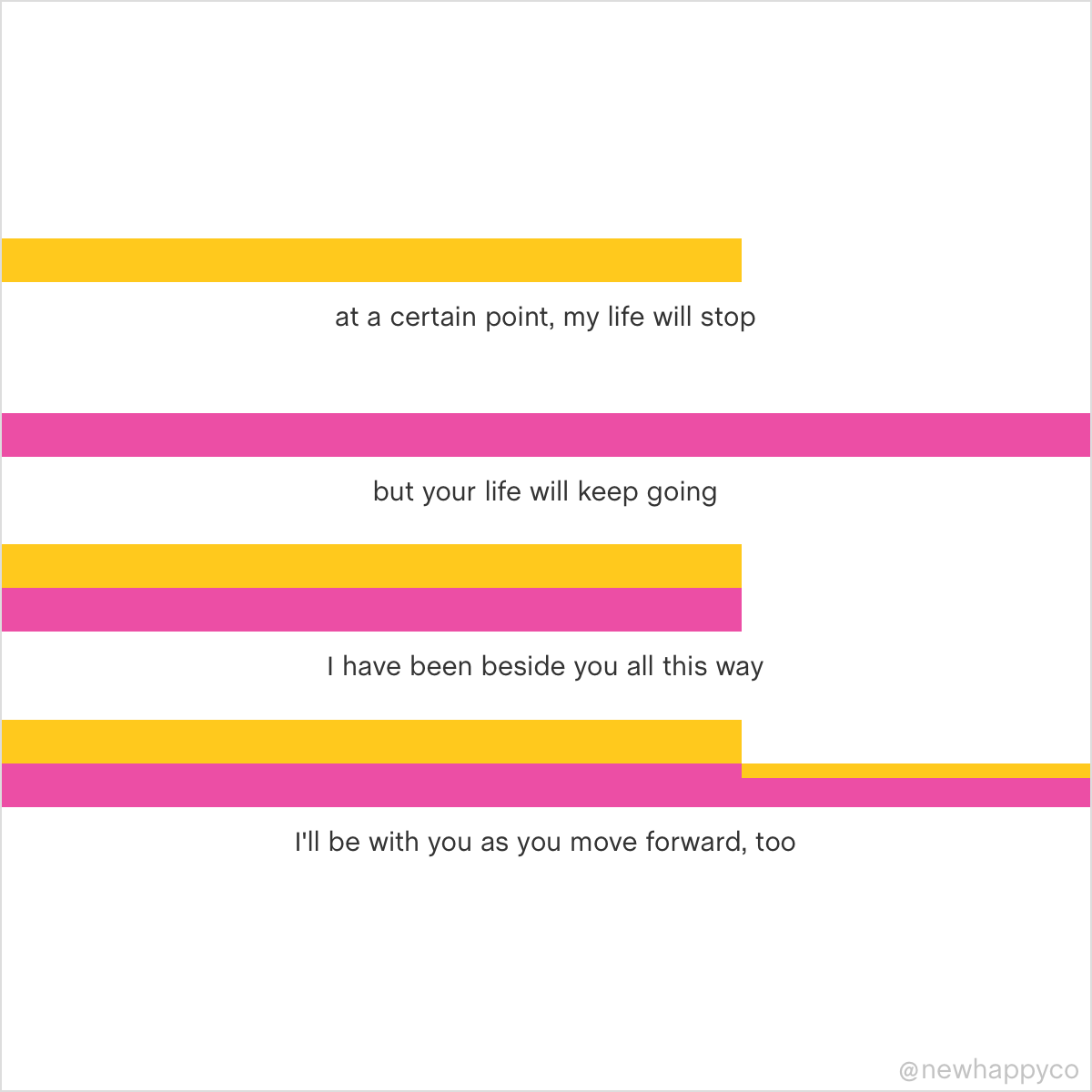
In his book A Grief Observed, C.S. Lewis exposes his most painful emotions in the days and months after the tragic death of his wife.
As he describes it, “I thought I could describe a state; make a map of sorrow. Sorrow, however, turns out to be not a state but a process.”
The neuroscientist Mary-Frances O'Connor, who studies grief, argues that our brains create maps that pinpoint the physical location of our loved ones. Grief is what happens when that map no longer works — our brains cannot find our person anymore. We have to discard that map and come up with a new one, while also creating a new relationship with the person we've lost. I think that's the process that Lewis was talking about.
From a neuroscience perspective, O'Connor argues that this person remains with us: "They are not gone, because they are with us in our brain and in our mind. The physical makeup of our brain — the structure of our neurons — has been changed by them."
How can you honor and love the person (or hope, or animal, or part of yourself) that is no longer here? What would a new relationship with them look like?
Here are a few affirmations you can use as you move with grief:
"I allow myself to feel anything that I am feeling, without judgment."
"I will be kind to myself at each step, remembering that grieving is a process."
"I will trust that I can make a new map, one that continues to love and honor the person who I miss."
More Tips and Tools
1. Our hollow culture — Old Happy teaches us all the wrong lessons.
2. How to be there for someone who is struggling — Try the LOVE acronym.
3. Your ripple effect — You have so much power.
4. How to increase your motivation — Focus on your purpose.
5. Respond, don't react — Pause and choose a different approach.
6. You are worthy no matter what — This week's animation.
Or listen to the podcast episodes (Apple, Spotify) from this week!
Community
What is an important lesson you learned from someone in your life?
"I learned resilience from my mom."
"My partner taught me how to be brave and stand up for myself."
"A coach in school encouraged me to try out for sports, which changed my life. I learned that it's better to try even if you don't know if it will work out."
"My mentor in high school. She taught me how to believe in myself and that I was worthy of being loved and cared for. "My father taught me to always stand up for what's right."
"My boyfriend taught me that 'shoulds' and 'musts' are not laws. I am allowed to say no, even to my parents."
"I learned that I deserve to follow my dream and I have all I need within me."
Inspiration
1. A bride's prothesis, made to shine (NYT) — A remarkable and beautiful story.
2. A table read of the Muppets show (Tiktok) — I loved this glimpse into how they brought the Muppets to life!
3. The literature clock (Jene Voldsen, via Dense Discovery ) — This is delightful: a clock that tells you the time, using passages from books.
Before You Go
Listen to the Newsletter
No spam, just joy.
