

How To Be More Confident
There’s a simple secret to confidence, according to research. In this article, you will learn how to start becoming a more confident person.

Here’s a fascinating paradox: we all want to be confident, yet the only way to do that is to make yourself vulnerable.
The only way to build confidence is through doing hard, scary, and uncomfortable things. As Eleanor Roosevelt so memorably described it, “You must do the thing that you think you cannot do.” While it’s terrifying, there’s also a big reward waiting for you: a deeper, stronger sense of confidence in yourself and what is possible in the future.
Stop saying, “I’m not confident enough to try that.”
Start saying, “I’m scared to try that, but I’m going to anyways, because I know it will make me confident.”
Read Next
How To Be Grateful: A Simple Process For Practicing Gratitude
If you want to be a more grateful person, there are a few simple steps that you need to take. In this article, you will learn how to practice gratitude and why it matters.

If I was to ask you to, right now, name five things that are going wrong, you’d probably have an immediate answer:
You didn’t sleep well last night
You have a big deadline coming up
You have a lingering ache in your back
You’re frustrated with a colleague at work
You’re stressed about how to pay for a big upcoming expense
And if I was then to ask you to, right now, name five things that are going well, you probably wouldn’t have an immediate answer. You’d have to really stop and think about it. You might even struggle to come up with five things.
That’s because your brain has a negativity bias. At every moment, it is nudging you to pay more attention towards what is going wrong. From an evolutionary perspective, this is very smart: it protects you from danger. From a well-being perspective, this is very frustrating: it prevents you from seeing all of the good in your life.
Thanks to this bias, you often miss what’s going right—ignoring it, taking it for granted, or simply missing the opportunity to extract greater happiness from it. In fact, studies have found that most of us have more positive daily events than difficult ones, but because of this bias, it doesn’t feel this way.
That’s why one of the most important happiness skills is learning how to take control of your attention. That's what makes it possible to focus on what you want to see—not just what your brain wants you to see.
At any moment in your day, you can practice this skill. Here’s how:
At least once per day, pause whatever you’re doing.
Notice what your attention is focused on at that moment.
Consciously move your attention to something around that you that is positive, beautiful, or good. (Start small: the food you’re eating, a cup of tea, the sunshine.)
Keep your attention on it for at least 10-20 seconds. As you do, try to allow yourself to really appreciate its goodness and soak it in.
When you’re done, you might notice a change in your mood: you feel calmer, excited, or happier. And you might even notice that the world around you changes, too. For when we focus our attention on one thing that’s good, suddenly, we start to see so many other good things around us, too. Gratitude expands.

The Definitive Guide to Happiness
A groundbreaking new approach based on a decade’s worth of research and brought to life with beautiful artwork, New Happy shows you the proven path to happiness.
Read Next
How To Deal with Emotional Pain: A Simple Way To Manage Your Emotions
In this article, you will learn how to manage your emotional pain. We all feel difficult emotions from time to time. The best way to manage your painful emotions is to accept those emotions instead of pushing them away or ignoring them.
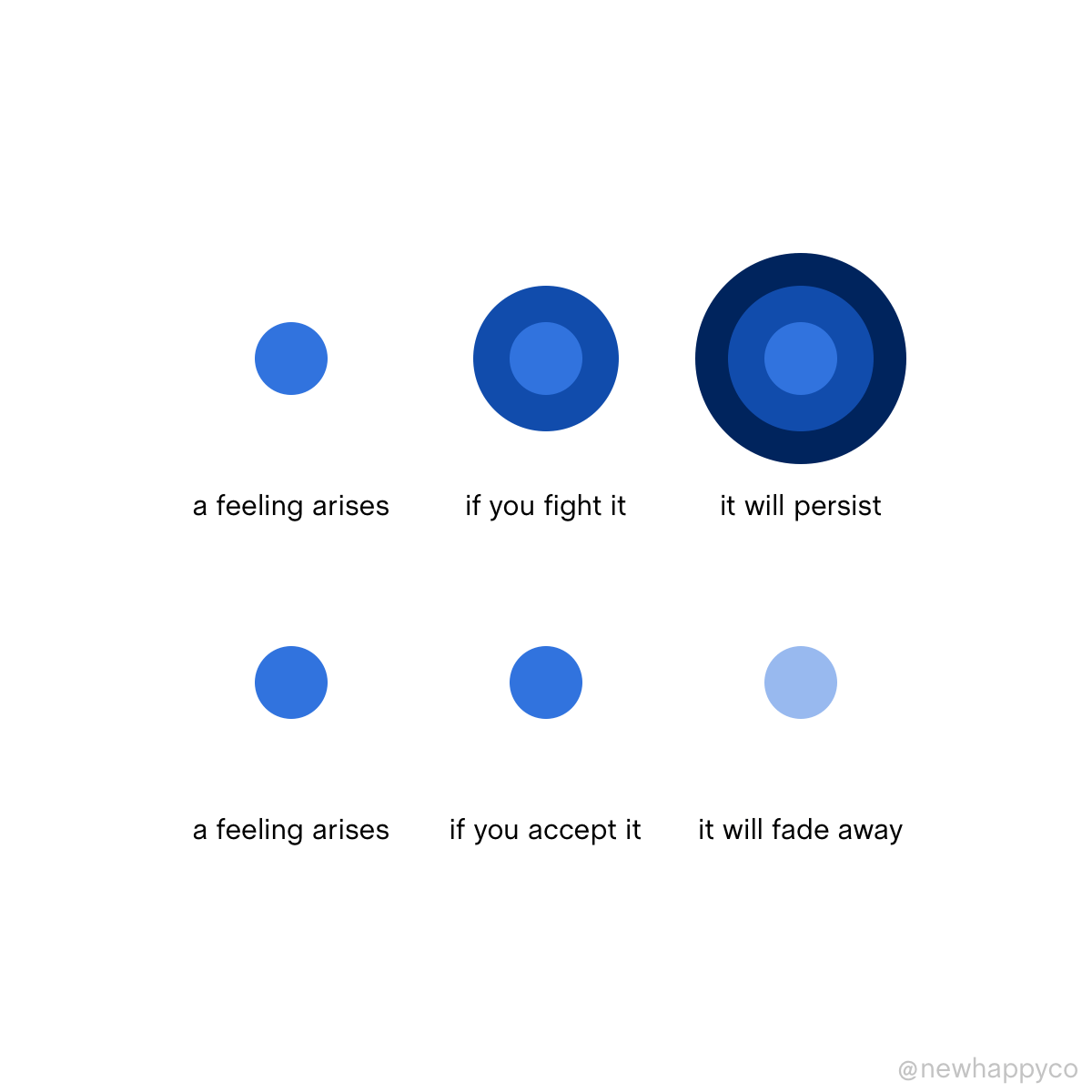
You're a human being. That means that you, like all other human beings, will experience painful and difficult emotions.
Instead of pushing these emotions away, viewing them as an indication that you're flawed or broken, try something new. Try to accept them, knowing that all they indicate is that you are a human being who is going through a particularly challenging moment.
Here's a powerful sentence to help you to do this:
"This is how it is, right now."
Say these words to yourself.
This pain is how it is... right now.
This sadness is how it is... right now.
This grief is how it is... right now.
In one sentence, we can accept whatever is happening in the moment. The magic of this sentence, though, is that it also reminds us that this moment will not last forever. Because that's another part of the human experience: that no matter how painful these moments are, they eventually do pass. And the sooner that we accept our emotions as they are, the faster that can happen.
The Definitive Guide to Happiness
A groundbreaking new approach based on a decade’s worth of research and brought to life with beautiful artwork, New Happy shows you the proven path to happiness.
Read Next
How To Increase Your Luck
According to professor Richard Wiseman at the University of Hertfordshire, you can make yourself a luckier person.
Science shows you can make yourself luckier.
Professor Richard Wiseman at the University of Hertfordshire is the leading academic researcher studying luck.
He’s spent his career seeking to understand the difference between lucky people and unlucky people, and discovered that there are very specific things that lucky people to do to increase their good fortune. Most importantly, he has also discovered that we can create more luck for ourselves through changing the way that we think and behave.
Increasing your luck isn’t about manifesting a vision or staying relentlessly positive or repeating what you want over and over again until it magically shows up. Just like we can consciously choose to put ourselves into a flow state, into a meditative state, or into a loving state, we can also put ourselves into a lucky state that then impacts our behaviors and thus, some outcomes.
In this article, you will learn the four ways to increase your luck.
Wiseman took these four principles and turned them into a ‘Luck School’, teaching unlucky people how to turn their fortunes around.
In total, 80% of people who attended said their luck had increased, and on average, they estimated their luck had increased by over 40%.
#1: Look for (and jump on) - opportunities
Lucky people have cultivated a particular skill in noticing and then taking advantage of opportunities. They tend to notice subtle opportunities and then find a way to take hold of them. Most people who describe themselves as lucky tend to be extroverted, optimistic, and most importantly, open-minded. By keeping a sense of curiosity alive and well at all times, you can see things that other people might miss. One of Wiseman’s studies found that lucky people smile twice as much and engage in more eye contact than unlucky people. That social interaction often leads to new opportunities for them.
One quick way to do this is to change up your daily routine and put yourself in new environments or new experiences. Another is to say yes to things that you would normally decline. As we get older, we tend to accumulate wisdom, which makes us feel as though we have the answers to life and that we know how it will unfold; by consciously adopting open-mindedness, we can try to stay more open to surprises and moments where our luck could change.
#2: Follow your gut
Lucky people listen to their gut feelings, and they act upon what they hear. They tune in and ask themselves how something feels, using any insights to inform their decisions.
They also consciously work to strengthen that ability by testing their hunches, learning from them, and finding ways to ‘hear it’ more effectively, like through meditating or creating mental space.
#3: Expect good things
Lucky people expect that life will be full of good things. Because of that belief, they tend to put themselves ‘out there’ more, as they believe that they will get what they want and aren’t ashamed to ask for it. This translates into raising your hand for opportunities, asking for things you want, and advocating for yourself, all of which have very positive outcomes.
(If you’re having trouble feeling this, remember that luck is also all about perspective. Someone out there believes that you are the luckiest person alive. If you are having trouble seeing that right now, put yourself in their shoes and imagine what it would be like to look at your life with that kind of awe and thankfulness.)
#4: Find ways to turn bad luck into good
And when inevitably, bad things happen to them, lucky people find a way to turn it into a positive thing. They tell themselves how much worse it could have been, try to control what they can of the situation, and practice their resilience skills to more effectively cope.
Wiseman’s experiments don’t stand alone as the only example of one’s mindset having extraordinary power: many studies have found that if you act as if something is true, it can bring about some of that truth. One famous experiment by Ellen Langer at Harvard brought eight 70 year-old-men from a nursing home into an environment designed to look exactly like their lives 20 years earlier. She instructed the men to pretend that they were 20 years younger. After a week, they showed improvements in strength, posture, memory, perception, cognition, hearing, and vision. Four independent volunteers looked at before & after experiment photos and rated those in the ‘after’ photos as an average of two years younger than in their ‘before’ photos. In her book, she writes that the men, some of whom had walked in to the study home needing canes, spent their last morning playing an impromptu touch football game on the front lawn.
There are obviously some very real limits to what your mindset can do; but your mindset can do an awful lot.
Pay Attention To Unseen Luck
One aspect of your luck that you can’t control is one of the most influential upon your life’s outcome: the circumstances that you are born into. In America, this is an extremely urgent and tragic problem. Studies have found that the family we are born into, our birth order, the neighborhoods we live in, the schools we attend, and our race and gender highly influence our outcomes in life. For example, one study found 74% of rich teenagers who score in the top quadrant in math earned a four year college degree; but only 41% of the poorest students with the same top math scores did so.
This ‘unseen luck’ promotes a horrible myth that only the worthy succeed. This myth is particularly exacerbated alongside of the American Dream’s argument that only hard work and talent are needed to get ahead, when in fact, there is so much that affects us that we do not have any conscious awareness of.
When we forget our fortune, our psychological biases make us start believing that everything good in our lives came about because of something special about us, rather than something special about our lucky birth circumstances. This then creates a feeling of superiority within people who have been the luckiest. For example, people from higher social economic classes have been found to be less attuned to other people’s suffering. Put together, you have a society where the born-lucky people can easily come to believe that they have earned their good fortune because of their talents, look down upon people who weren’t lucky and treat them with less compassion, and continue to perpetuate a myth that individual effort is the only thing that matters to success in life.
It’s essential that we practice gratitude for the external conditions that made our lives what they are. By doing so, we recognize that we are the beneficiaries of extreme good fortune and remember all of the things outside of us, that we had no control over that made it that way.
Proposing A Final Luck Principle
I want to add a final principle, a fifth, to Dr. Wiseman’s list: find a way to make others lucky.
Once you recognize how much good fortune has come your way, it becomes natural to want to find a way to increase the luck of others. Were you fortunate to attend an incredible school where you learned something special? Find a way to teach those things to others. Do you have a job that many people would dream of? Mentor others and help them to get there, too. There are millions of ways you can make other people lucky.
Your guidance, your time, your presence, your expertise, or your kindness might be the luckiest thing that someone else receives, something that changes their life forever.
What would it look like if you tried to live your life in a way that made others luckier? I suspect that it would make you feel even luckier yourself.
The Definitive Guide to Happiness
A groundbreaking new approach based on a decade’s worth of research and brought to life with beautiful artwork, New Happy shows you the proven path to happiness.
Read More
How To Become Wiser: 25 Questions To Ask Yourself
In this guide, you will learn what leads to wisdom and what does not. Get our list of 25 questions that will help you to become wiser.
You can’t become wiser by consuming wisdom. You become wiser through taking action.
Wisdom is something that develops with time and effort, through challenging yourself to look at situations from different perspectives in order to learn from them, examining your own behavior, and developing compassion for wider circles of beings.
Written wisdom can give you powerful and inspiring ideas about how to direct your action, serving like a North Star. But there’s no way to skip the work of becoming wiser. We need to grapple with these ideas, test and try them in our lives, and internalize them through trial and error. As Seneca said, “No man was ever wise by chance.” It’s a relatively rare attribute for a reason!

Here are 25 questions you can use to help you develop your own wisdom. Use them to pause, reflect, realign, and help you take the next, wisest action.
Seeking perspective
What’s another way to look at this?
What assumptions am I making right now?
How would an objective observer describe what happened?
Who is this benefitting and who is it hurting?
What would my wisest mentor advise me to think, ask, or do at this moment?
If everyone made this choice, how would it affect the world?
What are the ripple effects of this choice in the immediate moment, short-term and long-term?
Examining yourself
What would I do in this moment if someone was watching me?
What can I learn from this situation?
Where am I failing to uphold my values?
Is this choice helping me move closer to my values or further away from them?
How are my personal experiences, biases, fears, and goals affecting the way I am looking at this?
Are my words and my actions aligning (living with integrity)? If not, what do I need to do differently?
What is happening within me that I might be projecting onto another person or this situation?
How are my strengths and weaknesses affecting my response in this moment?
How have I contributed to this situation?
Developing compassion
What do I need in order to see this situation from a wiser perspective?
What would constitute a good outcome for everyone involved?
What’s the most caring interpretation of this person’s actions?
What needs is this person trying to fulfill right now?
How might this person or group be suffering right now?
What’s the choice that benefits the greater good?
If I’m judging someone, have I behaved similarly before? What was going on for me at that moment?
Is the choice I’m making leading to more love and compassion in the world?
Read Next
Motivational Quotes That Will Inspire You
Motivational quotes that will inspire you to achieve your goals and be your best self.
On this page, I have gathered some of my favorite motivational quotes and inspirational quotes. You can read them whenever you need a boost of energy, to refocus your attention, or to shift your perspective.
For a dose of inspiration and motivation each weekday, check out our newsletter.
“Don’t let the noise of others’ opinions drown out your own inner voice."
― Steve Jobs
“Life isn't worth living, unless it is lived for someone else.”
― Albert Einstein
“First forget inspiration. Habit is more dependable. Habit will sustain you whether you're inspired or not. Habit will help you finish and polish your stories. Inspiration won't. Habit is persistence in practice.”
— Octavia Butler
“Everyone thinks of changing the world, but no one thinks of changing himself.”
― Leo Tolstoy
“It is a brave thing to have courage to be an individual; it is also, perhaps, a lonely thing. But it is better than not being an individual, which is to be nobody at all.”
― Eleanor Roosevelt
“You may live in the world as it is, but you can still work to create the world as it should be.”
― Michelle Obama
“Dost thou love life? Then do not squander time, for that's the stuff life is made of.”
― Benjamin Franklin
“A joyful life is an individual creation that cannot be copied from a recipe. Happiness is a condition that must be prepared for, cultivated, and defended privately by each person.”
— Mihaly Csikszentmihalyi
“We are what we pretend to be, so we must be careful about what we pretend to be.”
— Kurt Vonnegut
“Work is love made visible.”
— Kahlil Gibran
“I can be changed by what happens to me. But I refuse to be reduced by it.”
— Maya Angelou
“The purpose of life is not to be happy. It is to be useful, to be honorable, to be compassionate, to have it make some difference that you have lived and lived well.”
— Ralph Waldo Emerson
“The hard truth seems to be this: We live in a vast and awesome universe in which, daily, suns are made and worlds destroyed, where humanity clings to an obscure clod of rock. The significance of our lives and our fragile realm derives from our own wisdom and courage. We are the custodians of life’s meaning. We would prefer it to be otherwise, of course, but there is no compelling evidence for a cosmic Parent who will care for us and save us from ourselves. It is up to us.”
― Carl Sagan
“And once the storm is over, you won’t remember how you made it through, how you managed to survive. You won’t even be sure, whether the storm is really over. But one thing is certain. When you come out of the storm, you won’t be the same person who walked in. That’s what this storm’s all about.”
― Haruki Marukami
“I hear you say 'Why?' Always 'Why?' You see things; and you say 'Why?' But I dream things that never were; and I say 'Why not?”
— George Bernard Shaw
“Ask yourself, “Who can I make smile this morning?” This is the art of creating happiness.”
― Thich Nhat Hanh
"What do we live for, if it is not to make life less difficult for each other?”
― George Eliot
“The greatest use of a life is to spend it on something that will outlast it.”
— William James
“Service is the rent we pay for the privilege of living on this earth.”
― Shirley Chisholm
"The future is an infinite succession of presents, and to live now as we think human beings should live, in defiance of all that is bad around us, is itself a marvelous victory."
— Howard Zinn
“When I face the desolate impossibility of writing five hundred pages, a sick sense of failure falls on me, and I know I can never do it. Then gradually, I write one page and then another. One day's work is all I can permit myself to contemplate.”
— John Steinbeck
“A person doesn't have to change who he is to become better.”
— Sidney Poitier
“Your hopes, dreams and aspirations are legitimate. They are trying to take you airborne, above the clouds, above the storms, if you only let them.”
— William James
"However difficult life may seem, there is always something you can do and succeed at."
— Stephen Hawking
“You were born with wings, why prefer to crawl through life?”
— Rumi
“The most common way people give up their power is by thinking they don't have any.”
— Alice Walker
“If we listened to our intellect we'd never have a love affair. We'd never have a friendship. We'd never go in business because we'd be cynical: "It's gonna go wrong." Or "She's going to hurt me." Or,"I've had a couple of bad love affairs, so therefore . . ." Well, that's nonsense. You're going to miss life. You've got to jump off the cliff all the time and build your wings on the way down.”
— Ray Bradbury
“I have never met a man so ignorant that I couldn't learn something from him.”
— Galileo Galilei
“When one door of happiness closes, another opens; but often we look so long at the closed door that we do not see the one which has been opened for us.”
— Helen Keller
“Difficulties are just things to overcome.”
— Ernest Shackleton
You Might Also Like
How To Become More Motivated
Read Next
Free Inspirational Wallpapers
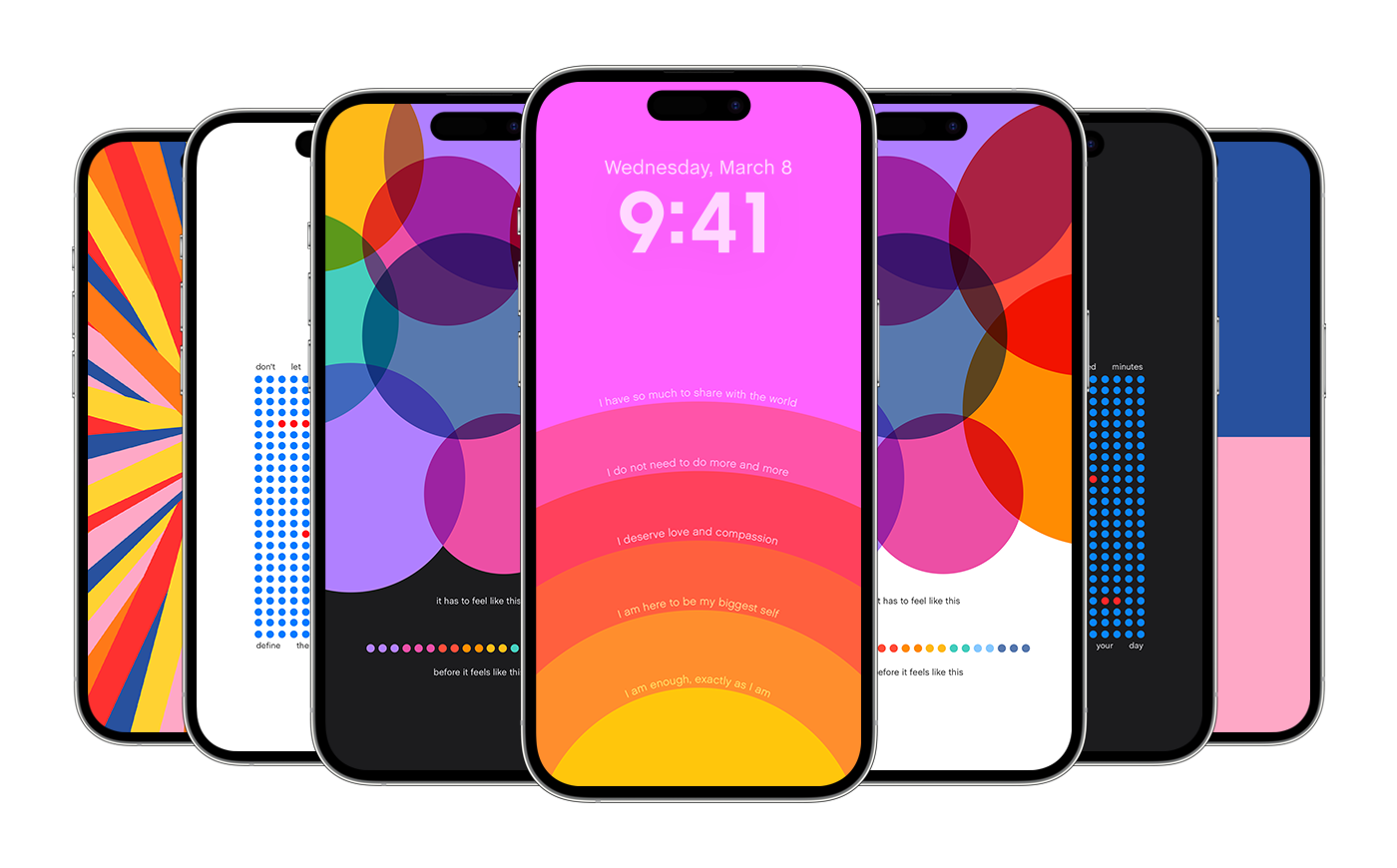
Free inspiring wallpapers that will motivate you to achieve your goals, treat yourself with kindness, and find your purpose — every time you pick up your phone.
The Feelings Wheel
Most of us were not taught how to understand and manage our feelings. Your emotions are not something to be ashamed of. You don’t have to control your feelings. You don’t have to feel shame for them. Your feelings are something to learn from and work with.
Most of us were not taught how to understand and manage our feelings.
Your emotions are not something to be ashamed of. You don’t have to control your feelings. You don’t have to feel shame for them. Your feelings are something to learn from and work with.
To do this, you can use the Feelings Wheel, which is a tool invented by Dr. Gloria Wilcox to help people to understand and label their feelings.

You can download a free PDF of the New Happy Feelings Wheel, along with a helpful guide on how to use it and work with your emotions.
Here is how to use the feelings wheel.
Start at the center of the wheel and identify which of the emotion families you think that you are currently feeling.
Then, go out closer to the edges and see how specific you can get.
Which emotion is closest to what you are feeling right now? If you’re having trouble, try eliminating the ones that you know that you aren’t feeling.
Then, label it out loud. Say, “I am feeling…”
Give yourself a few moments to pause and sit with this feeling. Allow yourself to notice how it feels in your body, the thoughts you are thinking, and how it changes as you’re paying attention to it.
Extensive research has found that labeling your emotions is one of the best things you can do to improve your mental health. Studies from UCLA and other institutions have found that putting your feelings into words makes them easier to cope with. For example:
Rating your anger on a scale of 1-5 reduces your heart rate, a measure of distress.
Describing your emotions when dealing with a phobia increases your courage in facing it.
Adding a label to an emotion (like "that's sadness" or "this is fear") decreases the activity in your amygdala, which is where your fight-or-flight response comes from.
The more specific you can be, the better. Learning to label your emotions at a higher level of granularity is also shown to help you regulate and work with them more effectively.
Read Next
The Definitive Guide to Happiness
A groundbreaking new approach based on a decade’s worth of research and brought to life with beautiful artwork, New Happy shows you the proven path to happiness.
How To Manage Your Anger
In this guide, you will learn how to manage your anger, how to control your reactions, and what your anger can teach you.
Let’s talk about one of our most challenging emotions: anger. It's challenging in two ways: hard to feel and hard to manage.
I like to think of anger as a wave. There are different types of waves. Sometimes, it’s a small one that breaks quickly and without much fanfare—that’s irritation or annoyance. Sometimes, it’s an enormous wave that has grown and grown as it rushes towards the shore, where it finally breaks with enormous crashes and noise—that’s fury or rage.
It’s perfectly normal to have your own waves of anger. You are human and therefore you will feel angry sometimes. It is an emotion that serves a critical protective function, not only in safeguarding your own well-being but also the well-being of our society. With wisdom, anger can be transformed into a force for good, like when it is funneled toward the pursuit of justice and peace.
Unfortunately, our instinctive reactions to anger don’t often serve us: studies show that it hurts our well-being to repress anger, stew in it, or express it through unconstructive ways like venting and criticism. We need to learn a new way to work with it, and here's one way to do so.

Download this piece as a wallpaper, in dark and light mode
Catch it as it begins
Pay attention to early signs that you might be feeling anger.
Do you feel more alert, more judgmental, more separate from others?
Do you notice physical signs, like a racing heart or sweaty palms?
Do you start speaking more loudly, or shrinking down, or feeling overwhelmed?
As you start to notice the anger building within you, name it: this can help you tap into the wiser part of your brain and reduce the intensity of the emotion.
Pause, step away and breathe
If you can, step away from whatever has brought this feeling about.
You might say, “I’m going to take a few minutes break from this conversation until I’m feeling calmer,” or “I want to have a constructive meeting, so let’s revisit this in the future when we’re both in a good place.”
This pause can sometimes act like a wave-breaker, preventing the emotion from becoming bigger than necessary. At the very least, it gives you the chance to shift into responding instead of reacting.
Care for yourself until it passes
If you can’t physically distance yourself, focus on your breath. Using deliberate breathing practices can help you to navigate the intensity of the emotion.
If you can take some space, you might want to go for a walk, do a workout, journal about your feelings, or do something else that supports your well-being.
Reflect on what it has to teach you
Once the wave has passed, you have the opportunity to reflect on what brought the anger about and what lessons it contains for you.
Some questions you might ask yourself:
What sparked this anger? Be as specific as you can.
Did an external event trigger something within me? Often, we become angry because of deep-seated pains that happened long ago.
Do I need to express myself? Identify if there was a violation of your needs or boundaries that might need to be addressed.
Have I felt this anger before? Repeatedly experiencing chronic anger can lead to stress and health problems.
What's my responsibility? Identify any actions that you might need to take.
How could I prepare for this in the future? Decide on a plan of action for the next time that you encounter this challenge or trigger.
The Definitive Guide to Happiness
A groundbreaking new approach based on a decade’s worth of research and brought to life with beautiful artwork, New Happy shows you the proven path to happiness.
Read Next
How to Start Meditating And Why It Can Change Your Life
In this beginner’s guide to meditation, you will learn how to start practicing in as little as one minute per day, why meditation can change your life, the scientific research backing meditation, and some unique techniques that you can use if traditional meditation hasn’t helped you in the past.
In this beginner’s guide to meditation, you will learn how to start practicing in as little as one minute per day, why meditation can change your life, the scientific research backing meditation, and some unique techniques that you can use if traditional meditation hasn’t helped you in the past.
What Meditation Is
Meditation is a practice where you train your attention.
As defined by the meditation teacher, Jon Kabat-Zinn, “the awareness that arises through paying attention on purpose, in the present moment, and nonjudgmentally to the unfolding of experience moment by moment.”
Meditation is an ancient technique that has been practiced in multiple cultures and religions for thousands of years.
How To Start Meditating
The easiest way to start meditating is to set a timer on your phone for five minutes and then close your eyes.
Focus on your breath and take a few deep breaths.
Count, from 0 to 10, with each breath in and out. When you reach 10, start at the beginning again.
When you find yourself getting distracted, don’t beat yourself up. This is what our minds do: they get distracted.
Just begin counting again at 0. Keep going until the timer goes off.
The Scientific Benefits Of Meditation
Hundreds of studies have been done on mindfulness meditation. One recent meta-analysis found that, for healthcare workers, meditation:
Reduced stress
Reduced anxiety and depression anxiety
Reduced distress
Improved burnout
Increased empathy and compassion
Improved emotional intelligence
Improved emotional regulation
Correlations have been found between mindfulness and lower levels of depressive syndromes, higher levels of subjective well-being, and higher levels of eudaimonic well-being.
Mindfulness meditation offers individuals a chance to engage in a different relationship with their subjectivity by standing back and observing one’s experience of the world. In addition, it is theorized that this process, known as ‘reperceiving’, can lead to additional positive outcomes that include self-regulation; flexibility in cognition, behavior and emotions; clarification of values; and exposure
Why Meditation Can Make You Happier
Meditation helps you to train your attention, which is one of the most important elements of happiness, because it is the single most powerful resource that you possess.
Attention shapes our lives through filtering through all of the available existing information in the world and selects only a small portion of it, creating the world that we perceive to be ‘reality’.
In this moment, as you read the words on this page, your attention is focused on comprehending and understanding the text. You’re probably not, at this moment, thinking about the way that your pinky toe is pressing into the bottom of your shoe — but now you are. Now it is in your attention. You can’t help but notice it.
We can’t possibly pay attention to all of the things that are happening around us. There is so much going on at any one time: the sounds, the smells, the noises, the flickering light, the way our clothes feel, our latest emotional pain, the grocery store list, the nagging worry about a mole on your arm, that email you’ve been putting off. Our attention can only handle seven pieces of information at one time, give or take two (coincidentally, the average number of digits in a phone number!) From the nearly endless supply of stimuli, our attention must be selective.
There are two ways in which we select the objects of our attention: involuntarily and voluntarily. Involuntarily, we find our attention pulled by sounds, movements, interest or habit. Voluntarily, we choose to point our attention towards something that we have deemed personally meaningful or important to us, something that is important enough that we are willing to neglect the other stimuli and focus upon it.
William James, the founding father of psychology, argued that “effort of attention is the essential phenomenon of will.”
It is not easy to control our attention, because there is no shortage of stimuli out there in the world that beg for your attention and that hope to capitalize upon your lapses into involuntary selection. Any application that has a pop-up notification captures your involuntary attention.
But attention is also what allows us to pursue and experience well-being.
Attention allows us to engage in many positive choices, such as:
Choosing thoughts and battling unproductive ones, which is a core skill of resilience
Envisioning our future selves and lives in order to set goals and objectives
Choosing to execute upon strategies and implement habits or interventions, or override unhelpful / habitual responses
We have very little control over what happens to us and over the ultimate events of our external lives. While we can certainly increase the probability that good things will happen to us through activities like building strong relationships, finding a job that fits our strengths, exercising and eating healthy, and so on, it is an unfortunate truth of life that these are only valiant attempts at very best. Even those of us who live the most blessed, fortunate life imaginable will absolutely come to know and deeply experience suffering. While it might seem bleak to recognize that the only assurance in this life is that we cannot control the external world, it is in fact something that can set us free.
Your attention influences how you feel about your life, your self, and the happiness and joy that you get from both. Your happiness comes from cultivating inner harmony through the power of your attention.
The most expedient way to improve the quality of life is through taking responsibility for one’s own attention. Mindfulness and meditation is one way that you can do this. Through training your attention to observe your experiences, reframe your perspectives, and cultivate positive states, you will be able to increase your happiness and well-being.
Unique Meditation Techniques
If you have tried traditional meditation techniques and struggled to make them a habit, don’t worry: there are many other ways that you can integrate mindfulness practice into your daily life. Here are several non-traditional techniques that you might try.
Visual Meditation: We created this visual meditation that will help you to direct your attention towards loving yourself. As the words change on the screen, mentally say them to yourself.
Moving Meditation: Stretch your body and, as you do, focus on how it feels in each muscle.
Group Meditation: Many meditation teachers offer in-person and virtual gatherings to bring people together to practice.
Loving Kindness Meditation: This practice helps you to cultivate greater compassion for others.
Mindful Walk: Go on a walk and stay open to witnessing your surroundings, like paying extra attention to the sights, sounds, and smells.
Read Next
How To Become Mentally Strong
Your locus of control is the degree to which you believe that you (and not external circumstances) have control over your life. It’s one of the key ingredients for mental strength. In this guide, you will learn how to build it.
Mental toughness is a quality that many people want to have. To be able to be resilient in the face of life’s challenges is an admirable thing. Yet it can be a difficult trait to cultivate. In this guide, I will explain how you can increase your mental strength by learning one essential skill: how to focus on what is within your control.
Why We Need To Learn This Skill For Mental Toughness
Human beings love control. We crave it. Studies from Rutgers University have found that we get a rush of dopamine (a rewarding, stimulating neurotransmitter) when we feel like we have the power to make a choice. Not much has changed from the time that we were babies, experiencing immense satisfaction and pride in banging blocks together because we were the ones who made it happen. Our brains want to have control and actively seek it out. We all have our own ways of creating control in our lives. Some of them are productive (like setting and achieving goals.) Some are less productive (like trying to control others.)
In psychology research, there is a concept called your locus of control. Your locus of control is the degree to which you believe that you (and not external circumstances) have control over your life. This is one of the single greatest contributors to your mental health.
When you have an internal locus of control, you believe that you have control over your own destiny, and that belief changes the way you act, think, and live.
People with an internal loci of control have greater psychological well-being, physical health, resilience, and lower stress. They are also more able motivate themselves to take action towards their goals, even when things are hard. When they do take action, it reinforces their belief that they have control in their lives. This in turn strengthens their internal locus, creating a positive upward spiral.
On the other hand, if you have an external locus of control, you believe that what you do doesn’t really matter. The world will do what it does, regardless of your actions. People who suffer from depression tend to have a very high external locus of control. As with the internal locus of control, it can lead to a spiral — but in this case, a downward one, where your beliefs lead to you not taking action, which then reinforces those beliefs that nothing you do matters.
How To Let Go Of What’s Not In Your Control
The first step is to identify what we can’t control in our lives. Many of us leak essential energy by spending our time ruminating on these areas, which then contributes to feeling that we don’t have control over our lives.
People with high internal loci of control have learned how to identify what they can’t control and how to redirect their energy to the places that yield positive results (which in turn, reinforces their internal locus of control!)
Grab a piece of paper and draw two circles—a big one, and a smaller one inside of it. Label the big one “Out My Control” and the smaller one “In My Control.” In the big circle, write down what you are focusing on right now that falls outside of your control.
Take a moment to reflect on what you wrote in the “Outside of my Control” circle. How much time do you spend ruminating on these, trying to control them, or anticipating what will happen next?
The first step is acknowledging, out loud, that you cannot control anything in this circle. As you start to acknowledge this reality, notice and feel any emotions that come up: this type of surrender can lead to powerful emotional releases.
Dig deeper and reflect on the ways that trying to control these externals is creating you pain. How has trying to control the uncontrollable affected your emotions, your energy, your relationships?
We place a tremendous burden upon our minds by asking them to control the outer circle — even though they are not remotely within our power to impact! Look at what you’ve written here, and reflect on what a hard job you’ve given your mind to do. No matter how hard your mind tries (and it has been trying very, very hard — that’s why it’s so tired!) there is no way that it can succeed.
Release your mind from this job, letting it know that it is no longer responsible for controlling anything that is out of your control.
Every time you feel the desire to control anything you’ve written in the outer circle, practice gently releasing it. I like to use the phrase, “I surrender this over” every time I notice myself trying to control anything in the outer ring. Doing this will release so much pressure and free up powerful mental energy.
We have to discipline ourselves not to give external circumstances power over our lives. When you notice that you are giving away responsibility for your happiness to anything you wrote down, like “I can’t be at peace until we know what’s going on with school,” it is a good cue that you are moving towards the external end of the spectrum. Instead, choose a more empowering phrase like, “I am frustrated by what is happening, but am choosing not to spend my energy on it.”
When you feel angry, sad, or frustrated about something in the outer circle, state your emotions out loud. Whatever you have listed in the outer circle will, at one point or another, stir up your emotions. That is completely normal. Instead of suppressing or ignoring the emotions, practicing naming them. Stating out loud that you feel sad, angry, or frustrated quiets the amygdala and other limbic areas of the brain that are responsible for feeling stressed, panicked, or afraid. When you label the emotion, you turn down the volume on the intensity of the emotion, allowing you to move from reacting to responding.
How To Focus On What’s In Your Control
One of the most famous psychology studies of all time was conducted by Dr. Martin Seligman who coined the concept of learned helplessness. He discovered that when an animal is repeatedly subjected to an inescapable negative stimulus like an electric shock, eventually, the animal will give up on trying to avoid the stimuli and accept it. Even when the animal is given an obvious chance to escape, they don’t try to take advantage of it, because they have come to believe that these electric shocks are their reality and that nothing they do matters. (See how this mirrors an extreme version of an external locus of control?)
Originally, psychologists thought this indicated that the animal learns to be helpless when it experiences challenges. However, recent studies have found that something much more interesting was going on. It turns out that we don’t learn how to be helpless. Helplessness is the default response to challenging experiences. It is control that must be learned.
In order to overcome our natural helplessness, we need to create mastery experiences by exerting control in our lives through solving the problems that arise. That’s why it’s so essential to take the energy we waste on what is not in our control and direct it towards what we can control: this is what helps us to overcome our default helplessness.
Every time we take control or solve a problem or work hard towards something we care about, we slowly rewire our brains to create what neuroscientists calls ‘the hope circuit’: the neural pathways that suppress our default helplessness response. People with strong hope circuits are able to bounce back from setbacks and respond to challenges with excitement and ease. They know they can get through this new challenge, because they’ve built a strong hope circuit. It’s also why some people struggle when they face setbacks: they haven’t had enough practice creating mastery experiences.
The next part of this exercise will help you to build your hope circuit. Turn back to your page and fill in the inner circle, the one you labeled “Inside of My Control.”
How much time do you spend thinking about these areas? If you’re like most people, probably not even close to the amount that you devote to the outer circle! One new idea to try out: view everything in the inner circle as your priority list, the parts of your life that deserve the most attention and care. Every time that you redirect your energy from the outer circle distractions to the inner circle priorities, you will be shifting your locus of control and building your hope circuit.
Resolve that, today, you will spend more of your energy on the smaller circle, and less of your energy on the bigger circle. Shifting your locus of control happens one small act at a time. Keep chipping away at it. Within a few days, you’ll start to feel more hopeful and empowered; and within weeks, you’ll be amazed at the difference you see in your well-being and resilience.
Expand Your Circle Of Control
The final step is learning how to discern if you can make a positive impact on anything in the outer circle. People with internal loci of control are masters at this practice. They can look at a horrible event, one that they have no control over, and skillfully identify what is within their power to make a difference,
Take a look at what you listed as outside of your control. Is there anything that you could do that would positively influence that situation?
This is an incredibly powerful way to shift your locus of control. It helps you to regain a sense of control in your life while also recognizing the limits of what you can do.
Our circles aren’t here to say, “this big problem is not in my control, so I abdicate responsibility for it.” Many of our biggest problems (like racism, inequality, and the current health crisis) need us to acknowledge that while we are not in control of the global outcome, our actions can make a major difference in our homes, communities, schools, and towns, which then in turn makes a difference toward the global outcome. You can further develop your internal locus of control by looking at the big picture problem and narrowing in on what you can do to help. And those actions really matter: if we all do our small part to take action in our selves, home, and community, they will add up to major changes.
Ironically, one of the best ways to help ourselves is to do our small part to help others.
Read Next
How To Manage Stress
While stress is inevitable, we can change the way that we respond to it in order to better support our well-being.
In this guide, I’ll walk you through the science of stress, how to manage stress, how to cope with it more effectively, and the practical tools that will help you to reduce it.
What is stress?
We experience both the physical and mental state of stress when we encounter a stressor. There are two forms of stressors:
A biogenic stressor creates a stress response no matter what (like caffeine or extreme heat and cold.) There is no mental component to these stressors: the stimulus naturally leads to the stress response.
A psychosocial stressor creates a stress response because we interpret it as a stressful event. For example, one person could be incredibly stressed by a confrontation while another person remains unruffled by it.
When faced with a biogenic stressor or a psychosocial stressor that we interpret as stressful, in less than a second, our brain triggers a massive cascade of neurochemicals that are sent around our body, limiting our ability to think clearly, manage our emotions, and respond effectively. Over time, if this happens over and over again, the cumulative effect of this stress response can lead to illness. (Read more about the biology of the stress response.)
There are two approaches that will help you to manage stress more effectively: change the way you face stress in the moment and change the way you think about stress.
How To Face Stress in the Moment
Here are several science-backed strategies that you can use the next time you are stressed.
When you feel stressed, take five deep breaths.
If facing a stressor is like pressing the accelerator in the car, taking a breath is like hitting the brakes. Breathing deeply activates our parasympathetic nervous system, which is responsible for calming down our stress response. When you notice that you are feeling stressed, pause whatever you’re doing and take five deep breaths. Visualization can also be helpful. Imagine breathing in golden air and exhaling red air.
Move around.
From an evolutionary perspective, the stress response existed to rapidly build energy to either fight off your enemy or to flee from it. In today’s world, our stress response is triggered so often throughout a given day (emails, instant messages, spills, bills, the list goes on...) but unlike our ancestors, we don’t have a specific use for that energy. None of us are charging towards our computers using our energy boost! Some scientists argue that the energy we build up inside of us needs to be ventilated through exercise. Release your stress energy however you can: jumping jacks, a quick walk, throwing punches. Any form of movement will dissipate the energy and also minimize the long-term impact of the stress response.
Additionally, exercise creates an essential growth factor in our brains (known as BDNF) that enhances resilience, neuroplasticity, our ability to learn, and protects us from chronic disease. The more movement you can fit into your day, the better you will be able to handle and recover from stress.
When you notice you are stressed, label the feeling.
Using just a few words, you can quickly pause the stress response. Brain MRI studies have found that labeling our negative emotions reduces the stress response. Just saying, “I feel anxious” or “I am overwhelmed” pumps the breaks on our emotional reaction, making it possible to quickly return to a baseline state where you can calmly address the stressor.
At the bottom of this page, you’ll find a feelings wheel that you can use to help with this time. It’s a highly effective tool for managing stress.

Tell a loved one about your stressors.
Research has found one of the most powerful ways to minimize our stress response is to connect over challenges with family or friends. If you are stressed, don’t follow any instincts to clamp down: instead, share, open up, and let others in. We are far better able to cope when we face challenges with others. One study even found that holding hands with your partner while you’re in pain actually reduces the severity of the pain. Call a friend or other loved one you trust and let them help you.
How To Change The Way You See Stressors
The second strategy is changing the way you interpret psychosocial stressors. This rewires our neural circuits, slowly changing the psychosocial stressor into a more neutral, less stressful event in our lives.
Understand your psychosocial stressors
Some psychosocial stressors are very hard to change our responses to (like grief, loss, and fear), and expecting that of ourselves is quite unrealistic. But there are some stressors that cause us pain that we can more easily address. Today, as you go through your day, make a list of any psychosocial stressors you encounter. Give each a number between 1-10 for the amount of stress they cause.
Tomorrow, look at your list. Are there any stressors that you could reclaim control over? Is there a new way to engage with it that would make it less painful? Who in your life responds to this stressor with less pain, and could you learn from them? Is there someone who could take that particular stressor off of your plate? Don’t accept 7-10 stressors without trying to minimize them in some way. Even a one-point drop is a win!
Say to yourself, “This is a new challenge that I just haven’t mastered, yet.”
The challenges in your life are especially hard right now because most of them are new. Think about your first few months in a new job or school. You are learning everything for the first time. You don’t know who to ask for help. You aren’t sure what ‘good’ looks like. New things are cognitively and emotionally exhausting. But over time, as we all know, new things do get easier. Use the magic word — “yet” — and remind yourself that you just haven’t mastered this, yet, but you will, just as you have done before in other hard, challenging situations.

Adopt a new stress mindset
Our mindsets are the way in which we see the world, and they influence every action and behavior we take. Often, we live with outdated mindsets that no longer serve us. Think of them like your mental software (that’s long overdue for an upgrade!) Here are some of the most common mindsets around stress and your upgrade manual for each.
Shift from “I’m just not a resilient person” to “Resilience is a skill I can build”
Remind yourself that resilience is not something that you are born with. It is a skill that you cultivate. No one was born knowing how to ride a bike, and no one is born naturally resilient. You are capable of learning how to be resilient, and this moment is actually giving you a chance to do so.
Shift from “All of this stress is harming me” to “Stressful moments can help me grow”
Research has found that viewing stress as a danger actually leads to negative effects. People who had a stressful life and believed that stress was harmful had a 43% greater risk of mortality, compared to those who also had a stressful life and believed that the stress wasn’t harmful. You can shift your mindset to focus on what stress has given you from a positive perspective.
Here’s an example: most of us would say that we get through our hard times by relying on what we learned from previous hard times. Whether it was a setback, a loss, or a new start, we gain strength from the fact that we got through it and we learned valuable coping strategies that can be leveraged today. What are you learning from this moment? Believe that you can transform this moment into growth and purpose. Remind yourself that this chance to work through new problems will help you become stronger and to flourish in the long run.
Shift from “Life shouldn’t be this stressful” to “Any good life will have some stress”
Some people have come to believe that the ideal life is free from stress, and their life is therefore, wrong. This mindset is often connected to perfectionism. People believe that their ideal life needs to be free of stress to be perfect, and if it isn’t, there is something wrong with them. In fact, research has found that we only stress about what we care about, so a stress-free life would mean that you don’t have anything that matters to you! Remind yourself that there is no good life where there is no form of stress.

Offer yourself compassion
When you feel stressed, or when you forget to use these new strategies, don’t make it worse by beating yourself up for it! You are human and these are hard times. Not only are you overriding your own habits, but you’re also fighting millions of years of evolution that have given us a brain that focuses on the negative, gets easily stressed, and tells stories that doesn’t serve us. It will take time to unlearn old habits and learn new ones, and self-compassion is essential on the journey.
Self-compassion has been associated with greater life satisfaction, emotional intelligence, social connectedness, happiness, and optimism, and less depression, perfectionism, and anxiety. Give yourself a hug. Tell yourself you’re doing a good job and you believe in you. Cheer yourself on the way you would a loved one. You can be the best friend you’ve ever had!
None of these strategies intend to diminish the very real stressors and challenges that you are facing. We can’t eliminate stress, but we can learn how to think about and manage it more effectively. These strategies will not only help you to face stressors when they arise in the moment, but also support your long-term health and well-being.
The Definitive Guide to Happiness
A groundbreaking new approach based on a decade’s worth of research and brought to life with beautiful artwork, New Happy shows you the proven path to happiness.
Read Next
You Are Not The Average Of The Five People You Spend The Most Time With
There’s a popular quote that goes around, saying “You are the average of the five people you spend the most time with.” Here’s why this is a bad way to think about your relationships.
There’s a popular quote that goes around, saying “You are the average of the five people you spend the most time with.”
It’s one of those sayings that seems positive on the surface, but once we look a little bit deeper, find is actually reinforcing Old Happy.
The message is one of consuming: look at what other people are giving you, and if they’re not helping you achieve your self-interested goals, toss them and upgrade to someone else.
Instead, if you want to experience joy and meaning, we're far better served by taking responsibility for being the light: asking how we can contribute to those around us, choosing to embody love in all its forms, and striving to be the type of person that empowers others to be their best selves.
Read Next
How To Get Out of Your Comfort Zone
Here is a simple strategy that will help you to get out of your comfort zone.
It's scary to do what you want to do and be who you want to be.
Here's a useful tool that can help you harness your courage.
Instead of thinking of what you want as being ‘outside of your comfort zone’, think of it instead as the next step on your journey.
If you’re in a comfort zone, and the thing you want is outside of it, it feels like a huge leap you have to make. A zone is containing you; you’re either in or you’re out, and that leap from what’s known into the great terrifying unknown can make it feel even more overwhelming.
Thinking about it as your next step is far more encouraging. You’re already on the road. You're moving towards it. You don't have to do anything new. You just have to keep going.
The motivating question changes, from “How can I force myself to make this big, scary leap?” to “What’s one thing I can do to move a little bit closer to what I want?”
Courage and fear co-exist. This framing helps to quiet fear and empower courage, helping you to be the person you want to be and do the things that you want to do.
Read Next
How To Stop Living On Autopilot
It’s easy to live on autopilot and go along with the cultural conditioning of our Old Happy world. But at any moment, we can pause and take a step back, getting curious about how we want to live instead. And then start. Right here — in this moment, with one different choice.
It’s easy to live on autopilot and go along with the cultural conditioning of our Old Happy world:
Keep pushing harder and harder.
Keep striving towards an ever-eternal future destination.
Keep denying your unique gifts.
Keep ignoring our interconnectedness.
But at any moment, we can pause and take a step back, getting curious about how we want to live instead. And then start. Right here — in this moment, with one different choice.
Here are a few favorite questions to help you show up for your life in a more authentic, more joyful way. Choose one, and give yourself a moment or two to see what answers come up within you.
What is happening in this present moment that I can embrace?
What does my true self yearn to do?
What inside me needs to be expressed?
When in my life have I felt the most joy?
When and where have I lost a part of my true self? What’s one step I can take to reclaim it?
What do I need to support myself?
What am I feeling right now?
What experiences have made me feel connected to the world and humanity? How can I have more of those?
Who needs me?
How can I help others?
What one action would make me feel like I am living with presence today?
Living with presence is, ultimately, about creating a life that feels like you: a life that brings you the joy you deserve, a life that enriches our collective world.
Read Next
You Are Not Your Job
When you define yourself by your job or your work, you end up missing out on many important other elements of your identity.
You are not one thing.
When you define yourself by your job or your work, you end up missing out on many important other elements of your identity.

You are not your job; your life role or your responsibilities; your achievements; your past or present; your relationship; your body; your mind; your health; your personality; your present emotions; your pains; your experiences; your struggles; your productivity levels; or other people’s opinions or ideas about who you should be.
You are so much more: you are a human being who is full of love, who is unique and layered and multifaceted, teeming with beauty and goodness.
You are full of potential, so much of it already expressed and even more of it left to uncover, explore and share with the world.
And you are not a limited self, either. You are a part of this world, interconnected with people and communities and nature and all of humanity.
Any time you catch yourself operating under a limited definition of who you are, remind yourself: you are so, so much more.
Read More
The Power Of Integrity
Every day, you face the same two choices, over and over again:
I made a promise. Will I keep it?
I know what’s right. Will I do it?
When you answer ‘yes' to these questions, you’re living with integrity.
Integrity is one of those words: we all know what it means, but it's tricky to define. It's stumped scientists, too. A group of them analyzed all of the ways that integrity has been defined, finding at least five different definitions!
Eventually they settled on this definition: integrity is the alignment between your words and your actions.
It turns out that your choice to live with integrity affects your health and happiness, too.
A recent Harvard study found that people who live more moral lives actually have lower odds of depression! People who act with integrity have lower risk of lung disease, along with fewer limitations in mobility and daily activities as they aged.
To more deeply understand integrity, we can look to its origins. It is derived from the word ‘integer,’ meaning a whole number — not a fraction. If breaking promises, or saying one thing and doing another, fractures you, then integritykeeps you whole.
As you go through your day, ask yourself: Am I keeping myself whole?
Know that when you say yes, it matters. It adds up to great, positive changes in the world. I love how the poet Kenneth Koch describes its power:
AESTHETICS OF INTEGRITY
For every star in the sky
Someone is holding his ground.
To those who choose to hold your ground today, thank you for illuminating our world tonight.
Read More
You Don’t Need to Optimize Yourself
To live a creative life, you need to allow yourself to be a human being. That means learning how to stop measuring yourself by external metrics or by your productivity.
The word measure comes from the 14th century word mesuren: to deal out, to divide up.
It makes me think of a shared dish of food being ladled out into separate bowls. When you’re measuring, you’re taking something whole and splitting it apart.
In measuring yourself, you’re doing the same thing: you’re dividing yourself into pieces, separating your person from your results. Yes, this can be a useful strategy when peak performance is your most cherished goal. But if you're looking for happiness, I'd advise against it.
It’s all too easy to choose a metric (daily habits, social media followers, bank account balance, resume, compliments from others) and then turn it into your identity.
When we divide ourselves in this way, there’s an inevitable consequence: what you are measuring now must be maximized.
Just like when we were kids, our inclination is to look around at how much food our dining companions got in their bowls. Am I doing enough? How can I get some more? Life has turned, without knowing it, into a competition.
The truth (which we all know!) is that everything that matters most cannot be divided up into pieces.
These things that matter — your authentic self, love, friendship, creativity, generosity, purpose — are always whole. They can’t be divided, so they can’t be measured. And because they can’t be measured, they can’t be competed for. And because they can’t be competed for, they connect us to one another. And because they connect us to one another, they make us happy.
Read More
What To Do When You Are Creatively Stuck
Everyone gets stuck sometimes when they are creating. The solution to overcoming it is paradoxical: step away from what you are trying to do. The latest neuroscience research explains why.
The harder you push to solve a problem, the more stuck you can become.
Being a good problem-solver isn’t only about using logic, strategy, creativity, and empathy. It’s also about learning when you need to step away from the problem, to take a break in order to be able to solve it effectively. You are the problem-solver — that means that you need to care for yourself so that you can do the best job you can!
What’s more, stepping away might just help you figure your problem out. You might have experienced this before: you have gone for a walk or had a shower, and in the middle of it, experienced a eureka! moment. Focusing on something other than the problem can activate your brain’s default mode network, especially when you’re doing things where your mind can wander, like exercising or tidying up. It makes it possible for you to arrive at new insights or identify potential solutions.
The next time you're stuck, remind yourself to step away. Give yourself a break from trying to solve the problem, and the answer might just come to you.
Read More
What Makes A True Friend?
People who have close friendships have better psychological and physical well-being. And some researchers even argue that the single most important factor to living a good life is the quality of our friendships.
The first book I remember reading on my own was The Lion, The Witch, and the Wardrobe. I have a distinct memory of being so captivated by it that I refused to respond to my mom's calls for dinner.
Another series that bewitched me some years later was the Lord of the Rings. I know I’m not alone in having these texts be such important touchstones of my youth.
A few years ago, I was so delighted to find out that the authors of these books, C.S. Lewis and J.R.R. Tolkien, were also the best of friends. In 1926, one year after Tolkien began teaching at Oxford, he met Lewis during a faculty meeting. They soon bonded over their shared passion for mythology.
They agreed that science fiction and fantasy books were not what they could be — and set out to write their own. This mutual encouragement gifted us with two of the greatest stories the world has ever seen.
Both credit their friendship with being essential to the development of their creations. Tolkien shared an early draft of a Middle Earth story with Lewis, who encouraged him to keep writing. Lewis experienced a crisis of faith and turned to Tolkien, who encouraged him to bring these themes to his stories, leading to the world of Narnia.
Tolkien wrote:
"The unpayable debt that I owe to [Lewis] was not 'influence' as it is ordinarily understood but sheer encouragement. He was for long my only audience. Only from him did I ever get the idea that my 'stuff' could be more than a private hobby. But for his interest and unceasing eagerness for more I should never have brought The L. of the R. to a conclusion.”'
We all need a friend or two like this. As Lewis himself articulated, “Friendship is unnecessary, like philosophy, like art, like the universe itself… It has no survival value; rather it is one of those things which give value to survival.”
Thousands of years ago, Aristotle defined three types of friendship.
Friendship for pleasure (two people go to the bar to have fun)
Friendship for utility (two people with complementary skills work to achieve a project)
Friendship for virtue (two people help one another become their best selves and develop their souls)
By all accounts, Tolkien and Lewis loved to drink at the bar together. And I’m sure they also offered one another some level of utilitarian support. But by all accounts, they were mostly soul friends: encouraging one another to dig deep into their imagination and to persevere in turning it into literary genius.
Scientific research tells us that true friends are essential to our well-being. Intimate friendships erect a protective bubble around us, buffering us from the negative effect of stress. People who have close friendships have better psychological and physical well-being. And some researchers even argue that the single most important factor to living a good life is the quality of our friendships.
How to find your soul friends
Here is the little known secret to finding your soul friends: if you want to have one, you can start by being one!
We are wired to mirror the behavior of others. And we naturally want to reciprocate what we receive. You can sometimes transform pleasure or utility friends into soul friends, simply by being the type of friend you want to have. And once you know what it’s like to have soul friends, you can set your bar for future friends at that level. (I’m always here to be your soul friend, too!)
Here are three quick strategies you can use to be a soul friend:
Hold Up The Mirror
Aristotle argued that becoming better could happen by holding up a mirror to your friend, showing themselves a view that was otherwise impossible to see. One way to do this is by sharing what you have learned from them. By doing this, you can help them to see their highest and best qualities, which might not be in their awareness.
Ask A Deeper Question
We tend to recycle rote questions in our interactions. Be the friend who asks the deep, thought-provoking questions. This will invite vulnerability, which facilitates faster bonding and deeper relationships. What would you do if money was no object? Who do you admire most in the world? What is your definition of success? What do you want your legacy to be? Questions like these can open up transformative, life-giving conversations
See Your Friend As Yourself
Soul friends see their friend as a part of them — they celebrate their wins and feel their pains as though they were their own. Be the first person to celebrate them. Be the first person to follow up after a challenging experience. Let them know when you think of them, and think of them often. Being supportive in this way is so powerful.
Read More
How To Become A Wiser Person
It is possible to become a wiser person. In this article, learn the simple and essential habits that will help you to learn wisdom.
In the 1500s, one man sat down and invented a word we all take for granted: essays. In his native French, sitting in his family’s chateau, Michel de Montaigne put his pen to paper and created the first modern essay: a piece of writing that blended philosophy, stories, and the writer’s own perspective. Shocking and new at the time, it has become one of the bedrocks of writing in our modern world.
In his essays, Montaigne proposed the then-radical idea that the world was far too concerned with consuming other people’s knowledge, which he argued stifled original thought. Consuming knowledge also made us feel, quite mistakenly, that we were the wiser for having consumed it. He wrote, “It may not be difficult to store up in the mind a vast quantity of facts within a comparatively short time, but the ability to form judgments requires the severe discipline of hard work and the tempering heat of experience and maturity.” Wisdom was anything that would “help a man live happily and morally, and that we should gauge any knowledge by “its usefulness and appropriateness to our life.”
In the half-century since Montaigne lived, the production of "knowledge" has exploded, making the development of wisdom even harder to fulfill. Today, Americans spend an average of 11 hours a day consuming media — and while there are no statistics on it, I’d venture to guess that most of us spend seconds or minutes developing wisdom. We do trick ourselves into thinking our hours consuming other people’s thoughts make us wiser — but as Montaigne would remind us, that’s just knowledge for knowledge’s sake.
Developing wisdom is more important than ever right now, because it gives us a superpower: it helps us to navigate hard times and turn them into moments of growth, personal development, and benefit.
What if we chose to take this time of the pandemic, and use it to create the habit of cultivating wisdom in our daily lives? Strangely, it might be the perfect moment for it. By far, the strongest predictor of wisdom (accounting for more than 25% of the variance) is how we respond to life experiences. Wise people take whatever life hands them, and then they do something different than the rest of us: they use that life situation to help them develop wisdom. They consciously choose to make lemonade out of lemons. Wise people are able to take stressful, negative, hard situations, and use them to improve their well-being.
Imagine that you knew that any hard situation you faced could be transformed to ultimately benefit you? What a relief it would be! People who are wise are likelier to rate their lives as more meaningful. They are less affected by challenging external circumstances. And they are more compassionate.
While the research has multiple definitions for wisdom, my favorite breaks it into three parts, which support, build upon, and amplify one another:
Cognitive: developing a deep understanding of life and human nature, including the positive/negative parts of humanity and the unpredictability of life, and knowing how limited that knowledge is
Reflective: examining oneself and choosing to see things from different perspectives
Affective: accepting and empathizing with others, seeking out the positives, as well as developing a motivation towards helping others
The Roman philosopher Seneca wrote, “No man was ever wise by chance.” Unfortunately for all of us voracious knowledge-consumers, the research backs him up. Wisdom is something that has to be actively and consciously developed. But no one puts ‘become wiser’ on their to-do-list. Instead, we drown ourselves in other people's minds and lives. It's time to claim our birthright of finding our own inner treasures, heeding Montaigne's advice that "we are richer than we think, each one of us.”
Wisdom can be cultivated, one small step at a time. Here are some of my favorite research-backed practices for developing wisdom.
Cognitive Wisdom Habits
Accept the limitations of your knowledge. It is possible to not have an opinion. It is possible to not share your opinion. Add phrases like, "I don't know" or "I was wrong" or "I want to learn more before I comment" to your vocabulary. Remind yourself that you can change your views when you learn new information.
Seek out knowledge, and after consuming it, set aside a few minutes to reflect upon and integrate it. Rather than just jumping to the next article, book, podcast, or video, pause. What do you think about what you just learned? How does it challenge your existing mental models? Keep an ongoing document of your reflections, adding to it throughout the day.
Seek out different perspectives. Consciously and deliberately look outside of your personal bubble. Choose to read and engage with diverse voices, across every spectrum. Diversify your social media feed. Hunt for voices that are quieter. When you're investigating a topic, seek out information that disconfirms your point of view. Read multiple works on the same idea that approach it from different perspectives.
Do something different. When we get stuck in our standard routines and practices, we limit our chance to encounter new situations. Take a daring risk. Do something completely out of the ordinary. Respond differently to a situation than you normally would.
While consuming information, allocate a small part of your brain to analyzing the context of the work. When was it created? What are the author's biases, interests, and goals? How is that influencing you, in ways seen and unseen? This context will help you sift more effectively and with judgment through the content.
Reflective Wisdom Habits
Make a practice of taking a minute to check in with yourself for a minute after meetings, conversations, and projects. What did you learn? What did you struggle with? What created tension inside of you? How did you show up in alignment with your goals? Jotting these down will help you to ensure you're not letting important reflections pass you by.
Frequently ask for feedback to better understand your strengths and your flaws. The more self-aware you are, the more likely you are to be wise (ego-centric people are very low in wisdom!) My favorite way of asking for feedback, which ensures that you always get a piece of helpful data, is to say "What is one thing I could have done better in that situation?"
Journal. Writing for a few minutes each day will help you to notice patterns within yourself (to stimuli, people, challenges, and information) that you can then consciously address.
Meditate. Developing a meditation practice strengthens your 'attention muscle', which is what is used to label and investigate your thoughts and emotions. Meditation is essentially weight-lifting for wisdom!
Evaluate information based on your own values. As you engage with content, ask if it holds true for you and your experience, and how it aligns (or not) with your mental model, the person you want to be, and the world you want to live in.
When someone does something that upsets, confuses, or angers you, pause and ask yourself, "What am I not seeing or considering?" Our brains have a bias to judge others by their actions, and ourselves by our intents. Consciously looking for other information will help to form a more balanced picture.
Affective Wisdom Habits
Whenever you greet someone, mentally say to yourself, "This is a person like me who wants to be happy." This is one of the most powerful practices in my own life, and it engenders such deep love and empathy. From this place, you can accept people more readily and therefore, love them easily.
When someone is suffering, don't immediately try to fix it. Wisdom is knowing that what heals pain is presence and attention. While it can be uncomfortable, try instead to sit with them in their pain, and to help them to understand it more by asking questions. From this place of connection and empathy, you can help them in a wise way.
Every day, ask yourself how you can make someone else's life better. Consciously considering what you can do will help inspire greater motivation to help others. Doing it will in turn help you to learn and grow.
Practice looking for the positive. We all have a negativity bias which we need to consciously address. Choose to find things that are beautiful, loving, and true in your life, and endeavor to help others see them, too.
Why bother cultivating wisdom? In Montaigne’s view, wisdom leads to happiness. He wrote, “The most manifest sign of wisdom is a constant happiness; its state is like that of things above the moon: always serene.”
Read More


A groundbreaking new approach based on a decade’s worth of research and brought to life with beautiful artwork, New Happy shows you the proven path to happiness.
Order today to receive exclusive bonus gifts that will help you to get even more out of the book.
