

A Secret That All Successful People Know
Truly successful people don’t spend their time focusing on other people's decisions. They spend their time focused on their own.
Over the last ten years, we have built a number of tools, now known as 'social media,' that make it very, very easy to focus on what other people are doing.
A mere click away, there's an endless scroll where you can look at the choices that other people are making. Not just the choices of the people that you know, either — but the choices of the people who you look up to, or who you envy, or who wish you knew. You see their breakfasts and outfits and career milestones and break-ups and journal entries and vacations and music recommendations.
It's not necessarily our observation that's the problem. It's the response that it creates within us.
That response is an instinct, the result of thousands of years of evolution that have taught us to constantly evaluate one another and our place in the world.
We feel inadequate: "Why is their life so much better than mine?"
We feel judgmental: "That's the completely wrong thing to do."
We feel alone: "Everyone else has it all figured out. Why don't I?"
Truly successful people don’t spend their time focusing on other people's decisions. They spend their time focused on their own.
The next time you feel tempted to devote your attention to other people’s choices, say these words to yourself:
"Those aren't my choices. That's not my business. I don't need to focus my limited energy there.
My energy belongs here, with my choices, with what is within my control.
Now, let's focus: what matters to me right now?"
Read More
How To Stop Overthinking
Overthinking is a habit that involves dwelling on the same thoughts repeatedly. It can often turn into rumination, where you stay focused on negative emotions for a prolonged period of time, which can predict depression and anxiety as well as making symptoms worse.
Overthinking is a habit that involves dwelling on the same thoughts repeatedly. It can often turn into rumination, where you stay focused on negative emotions for a prolonged period of time, which can predict depression and anxiety as well as making symptoms worse.
Overthinking can be a difficult cycle to break out of. Here is a four-step exercise that will help you to do it.
Notice
Acknowledge that you're feeling overwhelmed, stressed, or agitated. That's completely okay. We all feel this way from time to time.
Acknowledge
Acknowledge what you're thinking. Remember: they're just thoughts. They don't define you, they are not more powerful than you, and they do not dictate what happens in your life. They are just fragments and representations of information bouncing around inside of your brain.
Extract
Take your thoughts out of your mind by writing them down.
It's often very difficult to find clarity on our thoughts when they're so busy bouncing around. Collect all of the thoughts and bring them outside of your brain and onto paper. Here, you can analyze them, organize them, challenge them, or clarify them.
Express
When you share your thoughts with another person. you once again are helping yourself to get the distance you need.
If you don't have someone to talk to that you trust, it can be worth exploring professional options or finding another way to process them outwardly, whether that's through movement, speaking out loud, or making a piece of art.
Read More
The Easiest Way To Make Your Life Better
When we think about changing our lives, we often imagine big goals and long-term changes. But, as it turns out, you can change your life in ten seconds with this science-backed strategy.
When we think about changing our lives, we often imagine big goals and long-term changes. But, as it turns out, you can change your life in ten seconds with this science-backed strategy.
“There is nothing good or bad, but thinking makes it so.”
These are legendary lines for a reason - this quote from Hamlet captures so much of the human experience, and one of the most frustrating paradoxes of our nature: so much of the quality of our life lies in the way that we interpret it, and yet we are not naturally inclined to interpret events in a way that serves us.
We get so caught up in life’s passage that we often forget to pause and focus on the many small, beautiful moments that bless us with their existence, in favor of the big hardship, or the next demand, or the hope of perfection.
Savoring is about pausing and appreciating what is, right now, in this moment, even if it is imperfect.
The academic definition of savoring is “the act of mindfully engaging in thoughts and behaviors that heighten the effect of positive events on positive feelings.”
That makes it sound way more complicated than it actually is: savoring is what you do naturally when you inhale the steam off of a cup of tea, when you put your hands close to the fire, when you taste a delicious meal, when you enjoy a glass of water after a hot hike.
Sometimes, when we experience emotions, we lean into them and luxuriate in them, and sometimes, we suppress those emotions if we feel if it is inappropriate. You also might have, like me, another voice in your head that tells you to move on past the moment and get on to the next one, dammit, because life is about being productive!
Research has found that savoring:
Improves the quality of our relationships
Improves our mental health
Improves our physical health
Enhance your gratitude
Facilitate greater mindfulness
Enhance your ability to get into ‘flow’ states
Inspires greater creativity
It also helps to guard us against one of our deep-seated cognitive biases that keep us from happiness: the impact bias. This is our tendency to overestimate the impact that events in the future will have upon our happiness. We believe that it is the big life events — the wedding, the new job, the new house — that will make us happy, but it is actually the small moments that have the greatest impact on our well-being.
How to Savor
There are so many different ways to savor, but here’s the quick and dirty instructions: take ten seconds and lean into your positive emotions, as though you’re bringing the picture of your life into focus. Go deep, hang onto your thoughts, and bring a deliberate quality to your thinking, drawing the positive into view. You can savor anything: the present moment, but also the future and the past.
There are four types of savoring:
Basking: being receptive to praise and congratulations
Thanksgiving: expressing gratitude
Marveling: losing yourself in the wonder of the experience
Luxuriating: engaging your senses fully
The secret to increasing your happiness is to just pause and use one of these strategies, for about 5-10 seconds, as often as you can.
Try these savoring strategies.
Savoring Strategy #1: Share with others
Seek out other people to share your experience, reminisce about a shared memory, or to collectively anticipate something in the future.
Savoring Strategy #2: Memory building
Take a moment to actively store images in your brain so that they will be fresh in the future, an activity which was delightfully called 'taking mental pictures' by the television show The Office.
Savoring Strategy #3: Self-congratulation
If you achieve something meaningful or positive, take the time to bask in your accomplishments. Tell yourself how proud you are of yourself! Each week, you can also take a moment to write down your biggest accomplishments of the week.
Savoring Strategy #4: Sensory-perceptual sharpening
Focus your senses on the specific stimuli that you want to savor, which will help you to narrow your focus. If you have ever been so immersed in a sunset so beautiful that all sound receded, all thoughts quieted, and sense of self faded away, you have experienced this type of savoring.
Savoring Strategy #5: Temporal awareness
Sometimes savoring can be bittersweet, of the bittersweetness of a beautiful moment that will inevitably pass away quickly. Reminding yourself of this truth can help you to remember to focus on where you are, right now. One study asked college seniors to bring awareness to the bittersweetness of their last few weeks at college by savoring twice a week; these students reported greater well-being than those who tried to repress the thought of the rapidly-approaching future.
Savoring Strategy #6: Count your blessings
Bring awareness to what you are grateful for in a specific moment. Acknowledge your great good fortune, especially if it is the result of the kindness of others.
Read More
How To Bounce Back From Hard Times
Everyone goes through hard times. The key is learning how to bounce back from them. In this guide, we’ll walk you through how to recover, be more resilient, and grow from setbacks.
Have you ever noticed that when you’re in a good groove in life, things start to magically become easier, and life transforms into something better? Things seem to flow more smoothly. You are more active. You’re more connected to people. You eat healthier. You’re kinder to others. Life is just good!
And then, when the opposite happens, when you’re in a rut, and it feels like you’re sliding down a slippery mountain of frustration? Maybe you eat a bit too much cake, and then feel bad about yourself, so you skip your regular workout, and then you sleep in, and then you don’t fall asleep as normal the next night, and then you eat unhealthy because you’re tired, and all of a sudden, you’re looking around, wondering how you got into this massive rut?
We all experience this in our lives. The key is learning how to get out of the downward spiral, and spark it’s opposite: an upward spiral.
The scientist Dr. Barbara Fredrickson has discovered that these spirals actually start with one simple thing, something so small that you might not ever have guessed it could have such a disproportionate impact upon you: an emotion.
The Science of Emotions
Emotions are a mind, body, and soul experience. As you experience a feeling, you will also experience changes in physiology (like a facial expression), in communication (like what you say in response), and in your perception of the whole world at that moment (like believing that it is a bad place).
Negative emotions have an enormous impact upon us. They impress themselves heavily upon us, far more strongly than positive emotions. It takes at least three positive emotions just to cancel out one negative emotion. The leading marriage researcher John Gottman discovered that happy marriages have at least five positive emotions to every one negative.
While negative emotions are really powerful, positive emotions carry their own secret weapons, too. First, they actually temporarily broaden your view of the world, making you more open, aware, and connected. Second, they also add a tiny bit of oomph to what psychologists call your ‘personal resources’, which are things like resilience, self-acceptance, and openness. Every positive emotion you have essentially contributes to a bank that you can draw from in the future when times are hard or when you really need some support.
The Power of Glitter Dust
Positive emotions have one last magical feature: they allow us to sprinkle glitter dust all over an activity, a place, a person, or a thing. Good feelings trigger a whole bunch of neurochemicals that lead you to really, really like whatever caused it. When we like something, we are attracted to it. We want to spend more time with it. We think about it all the time. We go out to get it.
(This is how we know we are in love: we have sprinkled our glitter dust all over another person, and so we think about them all the time, and want to be around them, and when we are around them, we experience more positive emotions, which adds even more glitter dust!)
Glitter dust leads us into these upward or downward spirals. If we sprinkle glitter dust on things that are good for us, like by finding a type of exercise that we absolutely love to do, we will find ourselves nonconciously drawn to do more of it, without ever needing willpower. We’re pulled towards it, like a magnet. Even more, our motivation towards it will continue to increase over time, because every time we engage in it, we put more glitter dust on it, which makes it even more compelling. Thus, the upward spiral!
Unfortunately, our neurochemicals don’t care if a behavior is positive or negative: they just know that they like it, and they want more of it. It’s all too easy to sprinkle it on things like chocolate cake and alcohol that make us feel really good in the moment, but don’t contribute to positive outcomes in the long run.
Where you put your glitter dust, then, has an enormous implication for whether you live in an upward spiral world or in a downward spiral world.
Sprinkling glitter dust over something is the easiest way to build a habit, a lifestyle, or a routine that serves your goals, because it will create nonconscious and continually increasing motivations for that behavior.
How to Retract Glitter Dust
Sometimes, we end up sprinkling glitter dust over things that we actually don’t want to give that power to, or we end up realizing later that it’s not a behavior that serves our goals, and we need to retract it. This is consistent with what we know about addiction in the scientific literature, and the way it manifests in the brain. Sometimes, we feel magnetized to engage in the things that we know are bad for us, and it’s really hard to use willpower to halt our engagement with it.
Here’s how to sweep off glitter dust of anything out there that doesn’t serve you, and to become free of it.
Let’s say that you’re trying to avoid stopping by your regular lunch restaurant. You always end up getting the hamburger there, because it’s so good, but you really want to eat healthier. To sweep off the glitter dust, focus hard on the bad things about that behavior: the disconnection from your values, the money you’re spending on it, how tired you feel a few hours after eating it, how you’re feeling a bit uncomfortable in your clothes lately, and anything else you can bring to mind. The more visceral and visual, the better. As you’re focusing on that, bring that feeling of ‘I feel horrible after eating it’ to the forefront of your mind. Focus really, really hard on it. Then let it go.
One way to tell how much glitter dust has accumulated on something is how often you think about it spontaneously. So every time you think about that hamburger or that restaurant, switch to focusing on that thought of ‘I feel horrible afterwards’. Eventually, the spontaneous thoughts will dissipate, and you will know that you are free.
How To Get Out Of A Downward Spiral
Some downward spirals are short-term and easy to snap out of; some of them last for years. It is often sparked by things that are well outside of our control. For example, losing a loved one leads to sadness. If you ruminate constantly on that sadness, it will make it more likely that you withdraw from things that give you energy, which will then make you fatigued. That fatigue will then make it more likely that you have even more sad emotions. Soon, you may start to see the world as a sad place filled with events that you cannot control, which leads to negative beliefs about yourself and the world. Over time, this compounds more and more, potentially leading to depression or other disorders. If you sense that you or someone you love is in a long-term downward spiral, it’s really important that you seek out professional help to get through it.
One helpful strategy is to figure out your silver bullets: the things that reliably bring you positive emotions.
For me, there are five things that usually help: exercise, truly connecting with someone, practicing gratitude, playing with my dog, and listening to music that makes me feel joy. When I notice I’m in a downward spiral, I try to prioritize one of the five to help me switch into an upward spiral. Gratitude and music are quick hits if I don’t have a lot of time, and puppy time, exercise and connection are usually things I can get to in 24 hours or less.
What are your silver bullets?
How to Build A Life Of Upward Spirals
Now that you’ve learned how to pull out of downward spirals when they happen, it’s important to also learn how to create a life that makes upward spirals easier to get into. One helpful strategy is known as ‘prioritizing the positive.’
Prioritizing the positive is all about making the time and the space in your day to do the things that are positive for you. It’s not about thinking positive — it is about doing positive.
Fredrickson recommends six key positive areas: each of them contributes to your happiness in the moment and contributes to your happiness in the long-run. A good goal is to try to incorporate 1-2 of each of them in every day, which will help put you into more upward spirals.
1. Being physically active
2. Being social and connecting with others
3. Learning something new
4. Pursuing meaning
5. Eating well
6. Caring for your self
Prioritize it by treating it as just as important as a work meeting or an appointment. Block off time for your activities and actually do them. You are making such a valuable investment in yourself and in your life every time you engage in these behaviors.
Look at those six categories up there and figure out something you absolutely love that fits into each of them. People who are into exercise like exercising! You might look at them and wonder how on earth they conned themselves into believing that, and the truth is, they probably found a specific activity they liked, which inspired them to become more active, which made them into different types of exercise. It got the glitter dust!
If you’re trying to be more active, find a workout that you actually enjoy, because it will make it far easier for you to do it, and you won’t have to use your willpower. You might not love eating broccoli, but love brussels sprouts. Meditation may not be your self-care of choice, but hiking is. Figure out the things you love that are good for you and don’t feel any guilt for pursuing them: it’s the best way to change your life for the better.
Finally, Fredrickson recommends that we stop looking at happiness as this big, far-off goal, where we ask ourselves, “How will I be happy?” and think about how to achieve it five or ten years down the road.
Instead, she counsels us to focus on creating positive emotions, right here and right now. Enjoy the moment. Savor the good things. Find ways to integrate joy into your life, and to see it for the important investment that it is.
In this way, you end up becoming the best version of yourself and creating the resources that will equip you for challenges that may arise in the future.
Read More
How To Be Kinder To Yourself
Many of us have been raised to accept that, to be successful, we have to be perfect. This perfectionism is often grounded in beliefs like, “I should never struggle to perform,” “I always have to get it right,” or, “I have to be the best at everything.” To be clear, those standards are impossible to meet — and often, detrimental to our success and well-being.
One Friday morning, early in my career, an email popped into my inbox. It was a client, inquiring about a weekly report. With a dawning sense of horror, I realized that I had completely forgotten to make and send it.
I quickly pulled the report together and sent it over, expressing how sorry I was for my mistake. My client couldn’t have been nicer about it. Despite their kindness, my internal voice couldn’t stop berating me: “How could you have made this mistake? What’s wrong with you? I knew you weren’t cut out for this job.”
Think back to the last time you made a mistake or had a setback at work. How did you respond? If, like me, you were extremely self-critical, ashamed, and stressed, or perceived yourself as a less worthy professional (or person), I want you to know that we’re not alone.
Why are we so hard on ourselves?
Many of us have been raised to accept that, to be successful, we have to be perfect. This perfectionism is often grounded in beliefs like, “I should never struggle to perform,” “I always have to get it right,” or, “I have to be the best at everything.” To be clear, those standards are impossible to meet — and often, detrimental to our success and well-being.
Studies show that perfectionism has significantly increased over the last two decades, to a dangerous effect. Young people hold unrealistic standards for themselves as, well as those around them. This perfectionism, in part, is driven by the societies we live in and the medias we regularly consume, many of which emphasize social comparison. Internalizing such idealism negatively affects everyone, but especially younger generations who are likely to be more depressed, more burned out, and less productive than the generations before them. The same research also highlights that perfectionism is a leading cause of increased anxiety and depression among young people in the U.S., the U.K., and Canada.
The truth is that mistakes, setbacks, and challenges are an inevitable part of our working lives. More importantly, they are necessary. There’s no way to grow, contribute, or make a difference without stumbling a little. Instead of meeting your mistakes with self-criticism, there’s a far better option: self-compassion.
What is self-compassion, and how does it work?
Self-compassion is a way of relating to yourself that is derived from Buddhist psychology. It was pioneered in academic research by professor Kristin Neff, who breaks self-compassion into three key components:
Self-kindness: Treating yourself with care and understanding.
Mindfulness: Accurately perceiving your thoughts, feelings, and experiences, without overidentifying with them.
A sense of common humanity: Recognizing that challenges are a part of the human experience.
Self-compassion has many benefits. It reduces feelings of anxiety and depression and improves your mental health. It makes you more resilient and adaptable. It helps you become more efficient and creative. Avoiding being harsh on yourself for every small misstep helps you overcome your fear of failure, admit mistakes, view them as a learning opportunity, and find new and creative solutions to move forward. In fact, a recent study also found that on days when employees were more self-compassionate, they made more progress on their goals and felt a greater sense of meaning at work.
That said, learning how to be kind to yourself takes time, effort, and practice. Here is a four-step strategy that I’ve developed to help me cut myself some slack and become more self-compassionate: CARE.
Here’s what it looks like:
C: Catch yourself being critical.
Often, our internal thoughts can feel like persistent background noise and be hard to turn off. One way to tune them down is to learn to listen to this noise with patience and care.
The next time you make a mistake, start observing the critical things you say to yourself. For example:
After noticing a typo in an email, you may say: “That was so irresponsible of me.”
After submitting your work, you may say: “That work wasn’t good enough.”
After speaking in a meeting, you may say: “That comment I made was so unnecessary.”
Bringing attention to these thoughts, in the moment that they come up, will help you identify them for what they are: just a critical or negative thought. When you notice yourself spiraling, stop and gently remind yourself: “That’s a very critical thought.”
While this action may seem small, it’s a significant first step. Only when we acknowledge the things that bother us can we begin to change them. So, think of this step as a critical intervention to learning how to treat yourself with more compassion.
A: Acknowledge your experiences.
When critical thoughts arise, they are typically born from bigger, underlying feelings. Delving deeper into what’s causing you to feel bad about yourself may be uncomfortable, so take your time.
There are several different challenges that we face at work. There are the big ones — like, losing a customer, not getting a promotion you had hoped for, or being laid off. Then, there are the smaller ones — a conflict with a coworker, a missed deadline, or forgetting to do something. In each of these moments, it’s completely normal to feel emotions like frustration, grief, anger, or sadness. While you might be tempted to suppress your emotions, a better strategy is to engage with them mindfully.
This practice is called emotional labeling and refers to identifying your emotions without judgment or reprimand. Instead, of just acknowledging that you’re being unkind to yourself, like you did in the previous step, here, take a step further to identify the emotions you’re feeling. The goal is to validate your experience and affirm your feelings, instead of running away from them.
For instance, if you missed a deadline, pay attention to your feelings. Are you angry? Sad? Upset? Frustrated? As you think more about this, say out loud to yourself: “I feel angry,” or, “I feel disappointed.”
Stating what you feel out loud quiets the amygdala and other limbic areas of the brain that are responsible for emotional processing. When you start paying attention to your emotions, it helps you see your feelings while making room for kindness.
R: Request your own compassion.
Now, ask yourself: “What would my most supportive friend say to me at this moment?”
It’s most likely that your friend will reassure you that you’re strong, intelligent, and capable, that you will bounce back from this challenge, and that you are loved, no matter what happens at work.
Visualize this situation, and try saying these words to yourself, with the same care and understanding. If it feels silly or awkward believing this, gain confidence from the fact that if your friend were to go through what you just experienced, you’d also use similar words for them.
Another way to request kindness from yourself is to create a simple mantra that grounds you in reality and releases you from the expectation of having to be perfect. Here are a few examples:
“I made a mistake today. But I’m not alone. Everyone stumbles and blunders.”
“Making a mistake makes me human. I’m allowed to err.”
“I’m letting go of the unkind expectation that I’m the only person in the world who can’t make mistakes.”
As you say these words to yourself, take deep breaths, put your hand on your heart, or close your eyes. Let yourself really feel this act of kindness, just like you would if it was coming from a loved one.
E: Explore the best next step
The CARE strategy is not only good for your well-being. It can also help you be creative and find new solutions to the problem you’re facing. That’s because compassion activates your parasympathetic nervous system, which reduces your stress and facilitates a more adaptive response to challenges. No matter your challenge, there is a way to move forward, and you’ll be far more likely to find it if you’re kind to yourself first.
Once you’ve offered yourself compassion, pause and, ask: “What’s one step I can take to improve this situation?”
For instance, if you forget to complete an important weekly task, think of ways to avoid that mistake in the future. You could, for instance, add a reminder or block an hour each week to work on the task. You can even send a reminder to all your team members if it’s a shared responsibility to ensure that the task is part of everyone’s agenda. Instead of taking on blame for your mistakes, use the incident as a lesson to find systemic and lasting solutions — something that everyone can benefit from.
. . .
If you’re used to criticizing yourself, self-compassion might feel foreign at first. Think of it as a muscle: the more you practice, the stronger it will become. Whenever you have a hard time extending yourself some grace, remember this: You deserve your own kindness.
This article was originally published at the Harvard Business Review.
Read More
How To Achieve Your Biggest Goals
Everyone talks about being consistent. But there’s something more important than consistency.
"How can I achieve my goals?"
If you look around for answers to this question, you'll likely get the same response over and over: choose the right goal, break your goal into small steps, be consistent with taking action.
But here's something that no one talks about, which is equally as important: be willing to make mistakes.
Be willing to try things that are new, and therefore, might be uncomfortable.
Be willing to sit with that discomfort, which might come in the form of embarrassment, confusion, disappointment, frustration, anger, and apathy.
Be willing to reflect on your choices, learn from your mistakes, and pivot to new paths if needed.
Willingness is the unspoken secret to success. In my experience, it's also the barrier that is likely standing between you and the things that matter to you. Without willingness, all of the strategy, planning, and execution is meaningless. You'll never feel ready to get started or prepared enough to get through the first hurdle.
Planning on how to achieve your goals is often the easy part. Being willing to embrace the discomfort that comes when you follow through with those plans — that's the hard part.
Just to make this even more challenging, as you progress towards your goals, your tolerance of discomfort needs to increase proportionally, too. You never 'get' comfortable; you simply get comfortable with more and more discomfort.
That's why we need to learn to view willingness as a skill, something we can practice and can get better at.
Here's one of my favorite tactics to help you get started.
The next time you're feeling uncomfortable, stuck, or like you want to quit, that's a sign you need to harness your willingness. Say this mantra to yourself: "To move closer to what matters to me, I am willing to sit here in this discomfort, knowing that it will not last forever."
Read More
What To Do If You Are Burnt Out
Burnout is the result of prolonged exposure to chronic demands and stressors. While it is most frequently associated with work, it can also result from other roles in life, such as being a caregiver.
Burnout is the result of prolonged exposure to chronic demands and stressors. While it is most frequently associated with work, it can also result from other roles in life, such as being a caregiver.
While the pandemic created long-term exposure to new chronic stressors, it was placed on top of our existing extreme-stress culture. As a result, burnout is now widespread, with one survey showing over half of the respondents report experiencing it.
Despite popular belief, burnout isn’t just about fatigue. The leading research has identified that it has three specific components:
Exhaustion
Cynicism (feeling negative about your work or your life)
A sense of ineffectiveness (believing that you cannot do the things that you need to)
Experiencing burnout can lead to multiple physical problems, such as fatigue, headaches, issues sleeping, and even more serious health conditions. We know from many studies that chronic stress, which often overlaps with burnout from work and other challenges in our lives, is a risk factor for many chronic diseases, too. Psychologically, burnout can lead to depression, anxiety, and extreme distress.

The pandemic exacerbated many of our existing demands and added new stressors. These include working from home with children, the economic crisis, widespread job loss, increased pressure to maintain performance in an uncertain economy, the loss of many of our positive routines and social support, fear of contracting the virus, and constant worry for loved ones. Members of specific communities have experienced this to an even greater extent: not only are members of the BIPOC community at a greater risk of burnout, but they have also experienced extreme additional trauma over the past years.
If you’re burnt out, it is not your fault
As the leading researcher in burnout, Dr. Christina Maslach, says, “The bottom line on burnout is that it is a social phenomenon, not an individual weakness.”
All of us have certain resources, and all of us have certain demands. Burnout occurs when the demands of a specific situation are too high for too long — your environment or situation is overpowering you and any resources that you have.
While you can increase your resources to help to cope with the environmental situation, that will not be sustainable in the long run. It is extremely problematic to ask employees to bear the burden of continually increasing their resources without companies also reducing their demands — but that is exactly what is so frequently happening.
Many of us can push through an especially busy month or two at work with tough deadlines because we know that there is a slower-paced schedule or a break around the corner. But when there is no end in sight, no sign of environmental changes, or no signs of support from your leadership team, your resources will eventually become depleted by those ongoing demands.
Burnout warning signs
One thing that is within our control is learning to spot our burnout warning signs. Burnout presents itself uniquely for each of us, based on our personalities, our work and home environments, the communities we are a part of, and a multitude of other factors.
Consider how you are feeling on each of the three dimensions of burnout: exhaustion, cynicism, and ineffectiveness. It can be helpful to look at your emotions and behaviors in each of those areas.
Do you feel tired and fatigued? Do you rest but never fully recover?
Are you feeling inadequate or like you can’t get anything done? Are you struggling to do the things that you need to do to take care of yourself?
Do you feel negative about your work or your purpose? Are people frustrating you or upsetting you more than usual?
How to address burnout
To manage burnout, take a look at your demands and your resources. Depending on how burnout is impacting you, it can be helpful to come up with a short-term solution and a long-term solution.
You will also want to take into account your experience of the three elements of burnouts and which is affecting you most strongly at this moment. For example, high exhaustion burnout might require more self-care; high cynicism burnout might require connecting to a purpose or to other people; high ineffectiveness burnout might require breaking big tasks into small, achievable wins.
Decreasing your demands
Start with evaluating what you can take off of your plate. Here are a few ideas to get you started:
Many of us have burdened ourselves with very high expectations for what we should do every single day. If you are worried that you might be experiencing burnout, it’s a good time to release yourself from them. What can you let go of right now? (Just because you let go of it doesn’t mean you can never pick it back up!)
Schedule time with your manager at work and discuss what is on your plate. If it is safe to do so, have an honest conversation about how you are feeling. What projects are work are not the priority? Where can you decline unnecessary tasks (like side projects or ‘nice-to-do’s’?) How can your manager better support you?
Take a break. If you haven’t taken your vacation days, schedule them right away. Consider exploring short-term leaves of absence if necessary.
If your workplace is a burnout pressure-cooker, as so many are, eventually, you will likely need to explore taking your gifts elsewhere. It is a painful truth that these environments are not likely to change anytime soon, no matter how hard you work. You are valuable and you deserve a workplace that supports you for who you are.
Increasing your resources
Take a look at your psychological, social, and economic resources, and evaluate where you can bolster them.
Make rest a non-negotiable. While this can involve tough tradeoffs, it is essential for you to cope with the situation you’re in. Can you fit in small moments of rest throughout your day? Can you take a day off of all work once a week?
Reach out and ask for help. When you’re burnt out, even this can feel like too much effort to expend. But spending ten minutes considering, “Where could someone in my community lean in to support me?” could pay off in tens or hundreds of hours of effort down the line.
Ensure that you are being a good friend to yourself. Be honest with yourself: where are you subconsciously holding on to Old Happy burnout beliefs, and how can you release them? With awareness, we can start to unwind the myths in our own lives: every time that we catch ourselves pushing ourselves too hard, saying yes to too many things, breaking boundaries, or deprioritizing what we need, and we hold firm, we are taking a radical step against Old Happy culture.
Reconnect to a purpose. How can you keep top of mind why you are doing what you are doing? Focusing on the beneficiaries of our work can help us to regain a sense of fulfillment and motivation.
Define the self-care habits that you need to stay strong. Then, hold yourself accountable for them. Often, we neglect them because we feel like we don’t have enough time — however, that feeling is often a sign that we need to do them more than ever!
The responsibility of leaders
If you are a leader, you have an absolute responsibility to create an anti-burnout culture. If your team is burnt out, it is not their fault — and it's your job to help fix it.
A study from Gallup found the top five reasons for burnout are:
Unfair treatment at work
Unmanageable workload
Lack of role clarity
Lack of communication and support from their manager
Unreasonable time pressure
Take a look at this list, and grade yourself on each item. Be careful not to base it on your experience of the workplace, but to consider what it is like for your employees (taking into account who they are, their roles, their lives and experiences outside of work.)
Once you’ve graded yourself, challenge yourself to implement systematic changes that will help you to improve each area. In what ways can you help your employees to increase their resources and decrease their demands? Adjusting deliverables, removing ‘nice-to-do’s from their list, canceling meetings, re-prioritizing or cutting projects, advocating for what they need to your boss — these are all things that you can and should be doing.
We’re well overdue on building a work culture that doesn’t promote burnout. With increased awareness about what leads to burnout, increased clarity on what is in our control, and a renewed sense of responsibility from those leading workplace institutions, we can start to take meaningful action to improve work for everyone. Burnout is a problem that must be solved with widespread systemic change, not only with individual effort.
The Definitive Guide to Happiness
A groundbreaking new approach based on a decade’s worth of research and brought to life with beautiful artwork, New Happy shows you the proven path to happiness.
Read More
Why Resisting Pain Turns It Into Suffering
Life is full of pain. But most of us are never taught how to acknowledge this, let alone to effectively face and experience it. Because of this, despite having the very best of intentions, we tend to respond to pain in ways that backfire and turn it into suffering.
Life is full of pain. But most of us are never taught how to acknowledge this, let alone to effectively face and experience it. Because of this, despite having the very best of intentions, we tend to respond to pain in ways that backfire and turn it into suffering.
A common response is to resist the pain. We pretend that everything is fine, even though we are despairing within. We suppress our emotions, deny our needs, or reject our authentic responses to events. We apply judgments to events, like “This should not be happening,” “This is bad,” or “I shouldn’t be feeling this way.”
Resisting makes the pain bigger, stronger, and more intractable. It adds a layer of suffering on top of the pain, keeping us stuck in narratives about ourselves and the world, and trapped in emotions like despair, anger, shame, and unhappiness.
There are many ways to resist reality.
We resist ourselves as we are by rejecting our authentic selves, comparing ourselves to others, and holding ourselves up to an impossible standard.
We resist our emotions, laboring under the belief that we are not supposed to feel pain, struggle, or experience the full range of human emotions. We use phrases like “I shouldn’t feel this way” or “I shouldn’t find this so challenging.”
We resist other people as they are, wanting them to be different, weaving tales about how if they would only just change, our lives would improve forever.
And we resist the world as it is. We want things to be different than they are. We want our loved one to not to be sick, we want a new job, we want a shorter commute, we want the past to be different than it was. All of these desires are completely normal and acceptable. But the resistance of what is does not change it. It only leads to suffering.
The antidote for resistance is acceptance. When we accept reality for what it is — especially when that reality is something that we desperately do not want to be true — we give ourselves the gift of peace and freedom. From this place of acceptance, we can also change what is within our control: learning how to live with it, healing from it, making it better, and using its lessons to help us help others.
This approach was outlined in Dialectical Behavioral Therapy, a highly effective therapeutic approach designed by Dr. Marsha Linehan. Outside of therapy, research into acceptance demonstrates its power. Studies have found that the more accepting of ourselves, the likelier we are to be happy. If you accept your painful emotions without judging them, you’re less likely to be psychologically stressed, and experience fewer mood disorder symptoms.
To accept something does not mean that you approve of it. It means that you are committed to no longer spending your energy fighting its existence. In making this decision, we allow the pain to run its course. We free ourselves up to see a bigger picture beyond the immediate challenge. And we can move past the experience, learning from it and letting it go, in order to find peace and freedom.
To move from resistance to acceptance, try taking these steps:
Acknowledge what you are resisting
What element of reality are you fighting right now: yourself, your emotions, another person, an event or experience? Write it down and acknowledge it, and bring your attention to how this resistance is creating more pain and suffering for you.
Give yourself space to feel your emotions
If you have been resisting, you have likely been suppressing or denying your emotions. Try journaling, talking to a friend, or working with a therapist. In allowing yourself to bring these to the surface and feel them, you create the possibility for peace. It’s like a thunderstorm: the lightning, thunder, and rain have to happen, to wash away the chaos and welcome in the sense of renewal.
Act as if
Acceptance is such a radical departure from resistance that we often do not know how to behave. Imagine a version of yourself who has completely accepted reality for what it is. What would this self do in this moment? Keep that avatar close, checking in to help you to steadily choose responses in line with your commitment to acceptance.
Recognize that pain is part of life
As Dr. Linehan says, “Life can be worth living even with painful events in it.” In accepting this deep truth, we can welcome in a greater sense of peace and self-acceptance. There is nothing wrong with us. We are simply doing our very best.
Read More
One Surprising Secret To Achieving Your Goals
To achieve your goals, you might think that you have to pursue them all on your own. In fact, sometimes what you need the most is a helpful friend.
It was the early 1960s, and beloved country singer Willie Nelson was struggling.
From a very young age, he had dreamed of being a musician. Now, living in Nashville, he was trying everything he could, but nothing was going right for him. He was teaching music lessons instead of getting gigs. He was selling other people his songs instead of playing them himself. The big record labels weren't interested in him. He was drowning his sorrows in alcohol and struggling with his mental health.
One night, things got so bad that, drunk on whiskey, he attempted suicide by lying down in the middle of the road waiting to be struck by a passing car. They all swerved around him.
The next day, one of his friends, a drummer named Paul English, stopped by to visit Nelson, who was hungover and still despairing that he would ever find a way to make it in the music business.
English told him to celebrate how far he had come and encouraged him to keep going, saying:
"I'm thinking of how these fools [record labels] are going to feel when you start having hit songs left and right. That's when they'll eat their hearts out for paying you no mind when they could have bought you for a nickel and nail."
With a friend in his corner, Nelson persevered. In fact, shortly after this conversation, he got his big break. He became one of the most successful country artists of all time, and at the age of 90, is still playing live shows to this very day.
Paul English became his longtime drummer, and they spent the next fifty years traveling the world and playing together. Writing about their friendship in his recent book, Nelson described how much that support meant to him:
“It was good being with someone who seemed to believe in me more than I believed in myself. He really believed in a rosy future at a time when I couldn’t afford to buy my wife a dozen roses.”
There will be terrifying moments in all of our lives. What helps us to be braver? Knowing that someone else believes we can get through it.
Paul English believed in Willie Nelson. You have had people who believed in you. And you can believe in other people. That's what we're here for. That's how we achieve our goals: together.
Read More
How To Make Better Decisions
Every day, you make thousands of decisions. Over time, those decisions end up shaping the course of your life. Here’s the problem: you’re not a rational person. No one is.
Every day, you make thousands of decisions. Over time, those decisions end up shaping the course of your life.
Here’s the problem: you’re not a rational person. No one is.
A substantial body of research has found that human beings make irrational decisions, thanks to a number of persistent cognitive biases that shape the way we evaluate our options and make choices. Unfortunately, because of the way we are wired, it’s hard to make good decisions that make us happy and easy to make bad decisions that make us unhappy.
Here is the good news: there is a specific set of tools, backed by science, that you can use to make better choices every day.
I will break these tools into two groups:
Stop making stupid decisions by avoiding cognitive biases
Make wiser decisions using mental models
How To Stop Making Stupid Decisions
The legendary investor Charlie Munger, vice chairman of Berkshire Hathaway, once said:
“It is remarkable how much long-term advantage people like us have gotten by trying to be consistently not stupid, instead of trying to be very intelligent.”
Our cognitive biases are what lead to stupid decisions. These biases are like automatic mental shortcuts that your brain has developed in order to make it easier to cope in daily life.
The leading researcher in the field, Dr. Daniel Kahneman, calls this automatic approach “System 1 thinking.” System 1 is a way of thinking that is nonconscious, immediate, and highly susceptible to the following thinking traps. In order to make better decisions, you need to use what Kahneman calls “System 2 thinking".” System 2 is a way of thinking that uses greater effort and deliberation.
There are common traps in your decision-making process that lead to unfortunate outcomes. Learn to avoid these and you will be able to make better choices.
Trap #1: Confirmation Bias
The confirmation bias makes you pay more attention to information that supports what you want to do.
To overcome it, ask yourself: What information would support choosing the opposite way I’m currently leaning?
Trap #2: Selection Bias
The selection bias is when you are choosing something, you focus on the positive attributes, but when we are rejecting an option, we consider the negative attributes.
If you are choosing something, ask yourself: What are the negative attributes of this choice?
If you are rejecting something, ask yourself: What are the positive attributes of this choice?
Trap #3: The Distance Bias
When we imagine the future, we tend to picture a version of it that is smooth and easy and carefree. If we’re imagining moving to a new city, we invariably imagine a beautiful day enjoying its’ many delights - not a rainy day, waiting for a cab, in the middle of running errands.
Ask yourself: What does a typical or less than ideal day-to-day of this decision involve?
Trap #4: The Easiness Bias
While most of have a very good idea of what makes us happy, or what might make us happy if we were to do it, we often don’t do it in favor of things that are easier! Many studies have found that there is a gap that exists between what what we know will energize us and how we actually spend our time. For some reason, we sometimes can’t seem to motivate ourselves to do what we know will make us happy.
We fall into the easiness trap when we make a decision based upon not what will make us truly happy, but what will be the easiest for us, cause the least amount of friction, or require the least amount of effort.
Ask yourself: Am I making this choice based upon how easy it is?
Trap #5: The Emotion Bias
Emotions are powerful, and they can be very helpful in making decisions when we have deep expertise in the area of our decision. Sometimes, though, they can seriously lead us astray - when we are either incredibly happy about something or incredibly upset about it, our emotions can become so powerful that they completely override the rational part of our brain and make it impossible to make good decisions.
Ever sent an email in a haze of anger which you then regretted? That’s the emotion trap at work. Ever said yes to something just because you were really happy? There it is again!
Ask yourself: on a scale of 1-10, how intense are my emotions right now? (If higher than a 3 or 4, take a break and revisit your decision later.)
Trap #6: The Accuracy Bias
We are bad at remembering how things in the past made us feel, which then leads to sub-optimal choices in the future.
For example, sometimes when I sit down to write, I really, really, really don’t want to. Despite having written for years and years, and knowing that it is pretty much a guaranteed route to happiness, it’s still somehow hard for me to remember that.
To counter this, we have to capture data that proves to us how we will feel once we just make a tiny movement. Write the things down that make you happy. Are they the things you tend to put off? What decisions have you made to avoid these things, when in fact you might want to move towards them?
Ask yourself: Will this decision help me to do more of the things that really do make me happy?
How To Make Wiser Decisions With Mental Models
Mental models are the way we think about and understand the world around us.
We get used to seeing the world through one specific lens, but if we consciously try out a new way of thinking, we can gain insights or expand our understanding. Try these models on.
Mental Model #1: Give advice to a friend
Take the ‘outsider perspective’ by asking yourself what advice you would give to a loved one who was in your situation. This helps us to have some distance from the decision, giving us an advantage in clarity and sometimes, an instant awareness of what the best choice is.
Mental Model #2: What won’t change?
When we contemplate a big decision, we usually focus our attention on specifically the parts of our life that will change. Ask yourself what won’t change. It will show you how much of your happiness is likely going to remain consistent. In my case, this question helped me to see that my relationship, my friendships, my dog, my apartment, and my hobbies (all things that are essential to my happiness) would stay the same, no matter what job I chose.
Mental Model #3: What you don’t do
We have a tendency to not want to walk away from things we’ve invested a ton of time into, be it a job, a relationship, a city, or a hobby.
On the other hand, though, we tend to regret the things we didn’t do, as we always wonder what would have happened. Think about what you will regret if you make the choice and what you will regret if you don’t make the choice.
Mental Model #4: Find a surrogate
We’re not special snowflakes: across the board, people tend to react very similarly to events and outcomes. Find someone who has gone through what you are contemplating - someone who moved from your city to that one, someone who moved from your company to that one - and dig into what their experience was like. Hearing their story, how does the decision feel to you? It’s more than likely that you will have a very similar experience to them. When studies ask people to use surrogates, they are remarkably accurate about predicting their own future feelings.
Mental Model #5: The big three
When we’re making decisions to optimize for happiness, we tend to overvalue an increase in money and an increase in relaxation time, and undervalue the impact of relationships. To counteract these, remind yourself of what I like to call the big three, the most important for experiencing consistent happiness and meaning:
Being engaged in what you are doing on a daily basis
Having positive relationships and spending time with the people you love
Having more control over your time and energy and what matters most to you
At A Certain Point, Let Go
It’s easy to get caught up in paralysis by analysis when making a big decision. At the end of the day, this is just an attempt to bring some sort of control to what is ultimately an uncontrollable situation. Uncertainty exists, and nothing in life is guaranteed. We can imagine that a particular outcome will be great, but we can never be certain. We might value things right now that won’t be as important to our future self. And, what’s more, choosing the ‘best’ option doesn’t mean that things will magically work out in the future, nor that choosing the ‘worse’ option mean that you are doomed to a life of unhappiness.
Yes, the decision is important. But it’s really what happens after the decision: the way you commit to it, immerse yourself in it, and think about it that matters so much more.
Here is one final piece of good news: we have something built in that helps us to cope no matter the outcome of a decision: once we’re committed to a path, we have a tendency to have a positive outlook and derive happiness from it, even if it was initially a less-than-desired outcome. Once we are stuck with a decision, we tend to see it as ours and to take ownership over it, which helps us to find the value, positives, and learning opportunities from the experience.
That’s the final tip: don’t linger on a decision too long. Set a date by which you will decide, commit to the decision, and then move forward.
Read More
How To Figure Out Your Values In Life
Figuring out your values is one of the most important things you can ever do. Your value are like your compass in life. They guide you towards what matters most to you.
Figuring out your values is one of the most important things you can ever do. Your value are like your compass in life. They guide you towards what matters most to you.
If you feel stuck in life… figuring out your values will help.
If you’re unhappy with your life… figuring out your values will help.
If you’re feeling lost… figuring out your values will help.
When you know what matters most to you, it becomes so much easier to change the way that you live, both on a daily basis and as you pursue your long-term goals. It helps you to identify what changes need to be made and how to do it. For example, if you value ‘relationships,’ but spend most of your time devoted to your career, you will likely experience unhappiness. Without knowing your values, though, this would be difficult to figure out.
This shift will bring you a sense of greater happiness, fulfillment, and meaning in life.
Below, you will find a list of values. We’ve also created a very special Values Wheel exercise that is designed to help you easily find your own values.
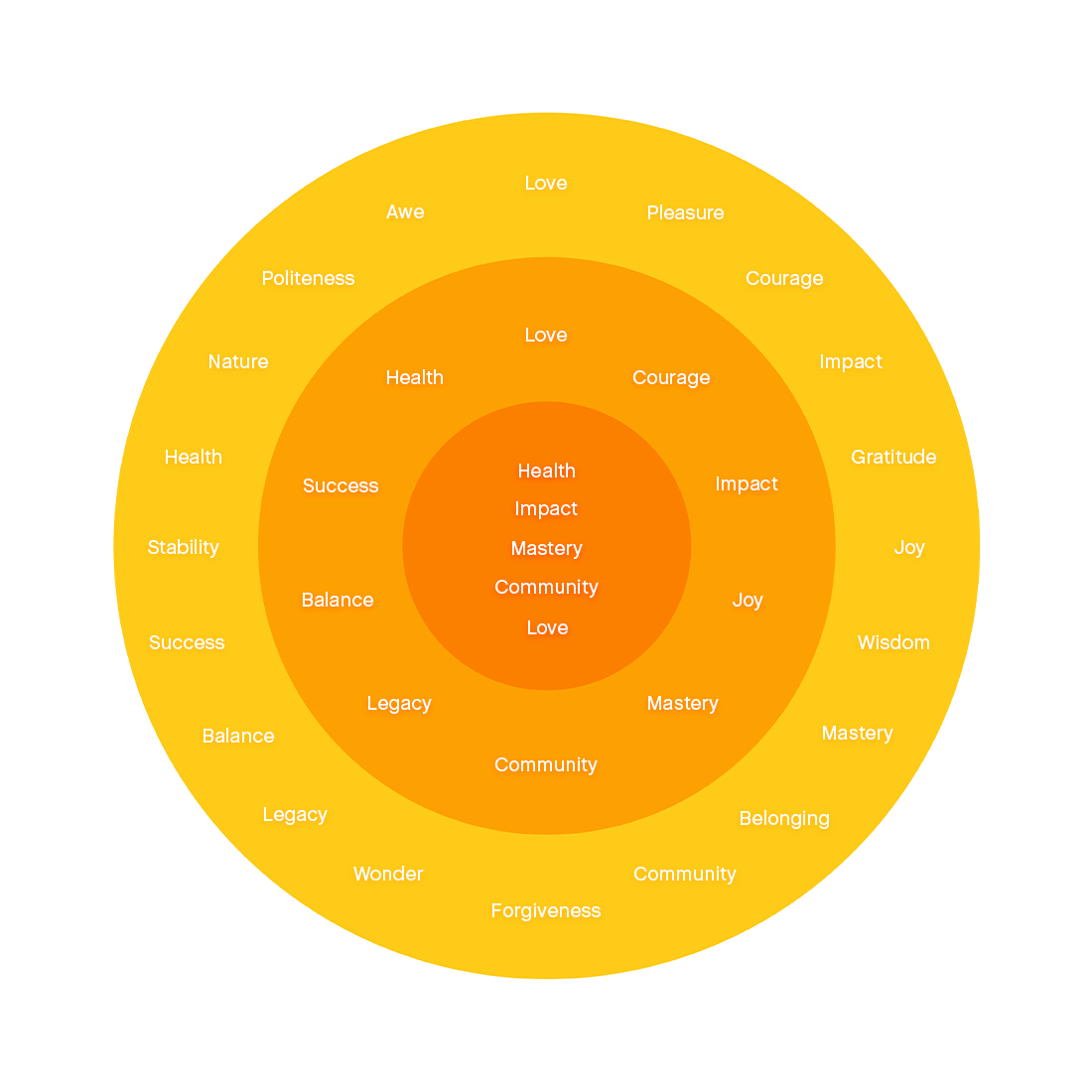
Download The Values Wheel PDF
A scientist named Shalom Schwartz has identified that there are ten universal values in life: Conformity, Tradition, Security, Power, Achievement, Hedonism, Stimulation, Self-Direction, Universalism, and Benevolence. I have grouped specific values underneath each of these.
To identify your values, start by selecting those that matter to you. Then, try to narrow them down, selecting no more than five and ideally two or three.
This new clarity on your values will help you to craft a happier life.
(For more insight into how to live by your values, you might enjoy our book NEW HAPPY: Getting Happiness Right in a World That’s Got It Wrong.)
Conformity
Accountability
Courtesy
Meeting Societal Expectations
Obedience
Politeness
Self-Discipline
Tradition
Community
Faith
History
Humility
Legacy
Loyalty
Respect for Others
Security
Approval
Balance
Belonging
Fairness
Harmony
Health
Stability
Wealth
Power
Authority
Competition
Control
Fame
Recognition
Reputation
Status
Achievement
Accomplishment
Competence
Mastery
Success
Hedonism
Abundance
Amusement
Bliss
Enjoyment
Pleasure
Stimulation
Adaptation
Boldness
Challenge
Confidence
Courage
Creativity
Determination
Exploration
Novelty
Vitality
Zest for life
Self-Direction
Assertiveness
Autonomy
Authenticity
Choice
Freedom
Focus
Honesty
Imagination
Independence
Open-mindedness
Passion
Self-awareness
Self-respect
Universalism
Accessibility
Acceptance
Awe
Consciousness
Diversity
Environmentalism
Heroism
Inclusion
Impact
Interconnectedness
Joy
Justice
Nature
Peace
Selflessness
Transcendence
Thoughtfulness
Wonder
Wisdom
Benevolence
Affection
Altruism
Charity
Compassion
Forgiveness
Giving
Gratitude
Kindness
Teamwork
Thoughtfulness
Once you have identified your values, write them down on a piece of paper or on your phone. It’s very important to keep them visible so that you can adjust your behaviors accordingly.
It can also be helpful to look at any gaps between your values and your current life. If you feel dissatisfied or frustrated with your life, it might be because there is a gap between how you want to be and how you are currently being. Look at how you spend your time: are you able to devote yourself to your values in a meaningful way? What might help you to move closer to embodying these values?
The Definitive Guide to Happiness
A groundbreaking new approach based on a decade’s worth of research and brought to life with beautiful artwork, New Happy shows you the proven path to happiness.
Read Next
What To Do If You Are Lonely
Loneliness can be devastating. Feeling lonely is associated with a greater risk of depression and can have a significant impact on our physical health. One study found that loneliness is more physically dangerous than obesity and as dangerous as smoking.
We all get lonely sometimes.
And we have been experiencing a loneliness epidemic in recent years. In one study, 25% of Americans reported that they didn’t have anyone that they could confide in. Modern society has disconnected us from our traditional way of being: immersed in constant close connection with friends, family, and neighbors.
Loneliness can be devastating. Feeling lonely is associated with a greater risk of depression and can have a significant impact on our physical health. One study found that loneliness is more physically dangerous than obesity and as dangerous as smoking.
When we think of loneliness, there are a few stereotypical images that come to mind: someone who is shy, someone who is isolated, an elderly person who lives alone. But studies have found that loneliness doesn’t result from living alone, being single, being elderly, or having poor social skills. Loneliness is a state of being that arises in tandem with real-life challenges: lonely people are significantly more likely to be experiencing very real struggles like medical issues, depression, or unemployment. What’s more, they feel that they are facing these challenges alone. No one is ‘in it’ with them to help carry the weight or to bear witness to their suffering.
Another way to think about loneliness is that it results from not getting the connection that we need. One of the leading researchers in loneliness, John Cacioppo, argued that loneliness is like the hunger cue for social support. Our stomachs growl with hunger when they need food. Our hearts growl with loneliness when they need connection.
If your heart is growling, here are three science-backed tools you can use to nourish your need for social connection.
Look for belonging cues
As the brain experiences prolonged loneliness, it moves into a state of self-preservation where it is simply trying to survive. It powers down the impulses to reach out, to connect, and to be empathetic (the very actions that we need to move past loneliness) in order to focus on surviving and fulfilling one’s acute needs. To overcome this unhelpful impulse, we have to train our brains to look for the belonging cues that help us to feel safe and connected. In every interaction, look for these cues — eye contact, outreach, questions, vulnerability, being invited to share your perspective. These are signs that you are connected, valued, and welcomed. In paying a bit more attention to them, you can move your brain out of this state of self-preservation and into a state of connection.
Offer your help to someone else
Another way to shift your brain out of a self-preservation state is to reach out to support someone else. If you’re feeling anxious or nervous about reaching out to someone, this is also a low-risk, high-impact way to do it. Send a message to someone and ask how they are and if they need any support. You can also participate in an already-established network, like your local Mutual Aid group or an online community.
Deepen your positive relationships
Often, loneliness can arise when we are surrounded by other people, even people that we love and cherish. In those moments, we are craving a deeper form of social connection that we are not receiving. Try to dig deeper with the existing people in your life by consciously inviting in more vulnerability to your relationship. One of the major barriers to more vulnerability is simply not knowing how to do it, but psychologists have discovered that it is possible to generate greater closeness through the questions that we ask one another. A few of our favorite questions are:
What do you think your greatest strength is?
What is the nicest compliment you’ve ever received?
What’s something you wish people knew about you?
What would you do if money was no object?
What is one of the best lessons you have ever learned?
When did you most surprise yourself recently?
What matters most to you?
You could also try the famous 36 Questions or a game like We’re Not Really Strangers.
And if you’re not lonely right now…
You have an opportunity to make a real difference in other people’s lives. Consider: who in your life is going through a major challenge right now? This person is at higher risk for loneliness. A quick text message or call might make all of the difference.
With a little bit of courage and effort, we can show up for one another and help to reduce the loneliness epidemic, one person at a time.
Tips from our New Happy community members
We asked our community what they do when loneliness strikes. Here are a few of their suggestions.
Feel the feelings:
“Allow myself to deeply feeling the feeling first”
“Acknowledge it, and remind myself that it is okay to feel lonely” — Eli
“Keep the phone away and try to feel the loneliness first”
Spend time with pets:
“Pet my kittens” — Flores
“Talk to my dog” — Fiorella
“Go for a walk with my dog and listen to music” — Claudia
Get out of the house:
“Listen to a good podcast while going for a walk” — Aakanksha
“Go on a hike!” — Mike
“Take a drive and enjoy the scenery, let myself be immersed in something else” — Justine
“Nature is the best friend a human can have” — Sin
Focus on being my own best friend:
“Invest in myself by learning new hobbies, like pasta making!” — Emma
“Spend time with myself, rather than others: exercise, self-care, a little shopping, whatever!” — Phoebe
“Write songs on my guitar” — Jim
“Listen to music or Broadway shows” — Hannah
“Have fun with myself and do the things I enjoy!” — Anastasia
Read Next
How To Be A Better Listener
Here’s a surprising secret: everything you want in life — good feelings, loving relationships, a purpose, success at work — can be facilitated by one key skill: being a better listener.
Here’s a surprising secret: everything you want in life — good feelings, loving relationships, a purpose, success at work — can be facilitated by one key skill: being a better listener.
Studies have found that good listening has three key behaviors: offering attention, seeking understanding, and conveying positive intention.
Here are a few easy ways you can be a more present listener.
Give the other person your attention:
Establish your capacity (“I have twenty minutes to talk right now, and then I will have to get back to work,” or “I need a bit of time to wind-down, and then we can spend time together!”)
Try to minimize distractions (put your phone down, turn off the television, choose an appropriate time for in-depth conversations.)
Be curious:
Summarize what they say (“It sounds like you’re saying…” and “What I’m hearing is…”)
Ask for clarification (“Am I getting this right?”)
Invite them to go deeper (“Could you share more about that experience?” or “What were you feeling in that moment?”)
Express care:
Extend compassion (“That must have been so painful,” or “What do you need right now?”)
Point out their strengths (“Your courage in that moment was awe-inspiring,” or “You always make me laugh.”)
Share your gratitude (“This was such a great conversation," or “I’m so thankful that you opened up to me.”)
Read More
How To Find Your Purpose
Just 7% of people believe that they can be fulfilled in life without being fulfilled at work. People with a sense of purpose in life are at lower risk of death and cardiovascular disease. Here are several simple steps to help you find yours.
Just 7% of people believe that they can be fulfilled in life without being fulfilled at work.
People with a sense of purpose in life are at lower risk of death and cardiovascular disease.
People want purpose so badly that a recent study found that 9 out of 10 employees would take a pay cut to have a lifetime guarantee of meaningful work, foregoing up to 23% of their lifetime incomes.
In 1992, researchers investigated purpose-driven organizations, and found that companies with a purpose and values-based culture achieved 400% higher revenues, 700% greater job growth and 1200% higher stock prices than those without.
But what is purpose, and how is it different than meaning? How does one find it? What happens when you don’t connect with your organization’s purpose? Is it really that important to find meaningful work? What if you think you have a purpose, but aren’t sure how to live it?
These are deep, complex topics that have produced a dizzying amount of research over the past thirty years. In this guide, we’ll break it down and help you to put it into practice for yourself so you can find the purpose you’re longing for.
Meaning vs. Purpose
Meaning is the end-result of having made sense of something or what that something signifies. An example would be interpreting the relationship between your life and your work. Individuals determine meaning for themselves, though it is impacted by their environment and social context. This gives you power to define meaning in your life for your self.
Purpose has two components:
A stable and long-reaching goal, something that we use to organize our lives.
A contribution to the world that extends beyond our own selves. Your purpose could be being a good parent, creating a positive environment for your team at work, or ending cancer.
Purpose is a pathway to meaning in life, but it is not the only one. Author Emily Esfehani Smith argues that there are three other paths to meaning: a sense of belonging, transcendence, and storytelling.
4 in 10 Americans have not discovered a satisfying life purpose, and 25% of Americans don’t have a strong sense of what makes their life meaningful.
On your journey to finding a purpose, there are four different groups. Read the list below and see which one you fall into.
Group One: People who have a purpose, and a job or hobby to express it within.
Group Two: People who have a purpose, and don’t have a venue to practice it.
Group Three: People who are not sure what their purpose is, but really want to find it.
Group Four: People who don’t feel like they need an overarching purpose, as they find meaning from one of the other sources.
We’ll now explore each of the first three groups in turn.
What to do if you are in Group One:
People who have meaningful and purposeful work are more likely to:
Be more resilient
Be more motivated
Have higher engagement at work
Have a greater sense of empowerment
Perform at a higher level
Experience greater fulfillment
Interestingly, purpose doesn’t protect you explicitly against work-related chronic stress. Autonomy does.
For those of you in Group One, who have found your purpose and a venue, a common challenge is an increased level of stress to match your heightened level of commitment to your purpose. The best way to protect against stress is to find ways to have more control over your time and activities.
What To Do If You’re In Group Two
There are three paths you could consider:
Take your job as it is today and make it more meaningful.
One of the best research discoveries in the field of positive psychology was that meaningful work can be crafted.
Amy Wrzesniewski, a professor at Yale, discovered that there are three orientations to work:
Job: Work provides income and resources
Career: Advancement in your occupation, towards the next job or rung in the ladder
Calling: Fulfillment from the work itself, and a belief that your work makes the world a better place
It probably won’t surprise you to learn that people who view their work as a calling have higher work satisfaction and life satisfaction.
Across multiple occupations, the distribution between job/career/calling is relatively evenly split. Roles we think of as being callings (doctors, nurses, teachers) are evenly split; and roles that we think of as jobs (janitors, electrician) are too.
To job craft, you can change the tasks you do, the way you do them, or the way you think about them. Ask, “How can I make this more purposeful?” We are capable of turning even the most disconnected-from-our-purpose jobs into something that is deeply meaningful and fulfilling. It turns out that it is your relationship to your work that matters more than the type of work that you do. However, this might not be enough for you - and that’s okay.
2. Look for another venue outside of your work for more purpose.
Are there nonprofits you could work with? Is there a hobby you’ve always wanted to try? Is there a specific cause that might need your support?
These are places where you can find your purpose. Spend a few minutes brainstorming any ideas that sound interesting and appealing to you.
3. Create something new.
I have a friend, a very talented artist, who started a brand to deliver her purpose of creating a more beautiful and equitable world. Another friend started his own company, coaching leaders on how to bring out the best in their teams.
For the second and third paths, the help of a good mentor or friend to bounce ideas off of can be extremely valuable. Is there anyone you can reach out to who’d be willing to dig into this topic with you? Send them an email now!
What To Do If You’re In Group Three
There are a few beliefs that get in the way of finding your purpose. Let’s explore each of them in turn.
Unhelpful Belief: "My calling is a thing that is out there, waiting for me to discover it.”
Better Belief: “It is my job to craft my calling.”
If you spend your life waiting for your purpose to alight upon you, you will be waiting a long time. The secret to finding your purpose is to go out and try as many things as you possibly can until one hooks you in a bit more than the others. You have to follow your blisters, not your bliss.
If you’ve ever even had a passing interest in a topic, it’s time to start playing with it. What are you interested in? Interest begins as a whisper, as a door quietly opening, usually in places that might be unexpected. In her excellent book Big Magic, Elizabeth Gilbert describes how interest blossomed for her she came decided to write a novel about the history of botany, The Signature of All Things.
Elizabeth moved into a new house, and she was staring out at her new garden, and decided to buy some plants for it. Then, she got a little bit curious about the plants that she had bought, heirloom irises. She googled it and discovered that these irises had originated in Syria. She thought that was interesting. That was it for the moment. Then, slowly, she began to explore the history of the other plants in her garden, and she began to discover the secret history of botany: “a wild and little-known tale of trade and adventure and global intrigue.”
She describes this journey:
“My search for more information about botanical exploration eventually led me around the planet – from my backyard in New Jersey to the horticultural libraries of England; from the horticultural libraries of England to the medieval pharmaceutical gardens of Holland; from the medieval pharmaceutical gardens of Holland to the moss-covered caves of French Polynesia. Three years of research and travel and investigation later, I finally sat down to begin writing a novel about a fictional family of nineteenth-century botanical explorers.
It was a novel I never saw coming. It had started with nearly nothing… but by the time I looked up from my scavenger hunt and began to write, I was completely consumed with passion about nineteenth century botanical exploration.”
Unhelpful Belief: If I just sit here and think enough about my purpose, or read yet another article on the internet about it, I will figure it out.
Better Belief: Introspection doesn’t lead to interest; interest comes from trying stuff.
Most of the people who are purposeful and passionate about something did not get to be that way through a magical lightbulb moment, but because they tried stuff, they got curious, and they started to investigate the topic, which led to more interest, and more curiosity, and more investigation…
It is our interaction with the outside world that provokes us into the state of interest, and we simply cannot predict what that interest is going to be; we can only be on the lookout for those tiny little whispers, and then follow them wherever they may lead.
As you begin to follow your interests, something else interesting happens… you start to get good at whatever it is you are pursuing. And that’s yet another path to well-being.
Unhelpful Belief: Purposeful work has to be hard and serious.
Better Belief: You can (and deserve to) find joy in the doing.
Studies have found that the most intrinsically motivated painters and sculptors are more professionally successful than those who are extrinsically motivated.
“Those artists who pursued their painting and sculpture more for the pleasure of the activity itself than for extrinsic rewards have produced art that has been socially recognized as superior. It is those who are least motivated to pursue extrinsic rewards who eventually receive them.”
What are the activities where time stops for you, where you are most engaged, where you feel most alive, where you are happiest?
Start by making a list of any small moment over the next week that is joyful, energizing, or engaging. Next week, take a look back over the list. You will find patterns, things that jump out at you, and maybe even something that you circle as something to dive more deeply into.
Read More
How To Become More Motivated
If you browse any corner of the motivational internet, you'll probably see one message repeated over and over again: You need to be consistent to achieve your goals. This is not, actually, the key to achieving your goals.
If you browse any corner of the motivational internet, you'll probably see one message repeated over and over again: You need to be consistent to achieve your goals.
This is not, actually, the key to achieving your goals.
If you want to achieve your goals, make them joyful. Make them fun. Make them interesting. Make them fascinating. Make them engaging. Make them meaningful.
If you do this, you will never have to worry about 'being consistent' ever again.
To understand why this is the case, let's dig into the research. You've probably heard of extrinsic and intrinsic motivation. These terms comes from a 40-year-old body of research, led by Edward Deci & Richard Ryan.
Their research discovered that there's a continuum of motivation. At one end is extrinsic motivation ("I'm doing this because I'll be rewarded/punished.") At the other is intrinsic motivation ("I'm doing this because it's joyful and interesting.")
(If you want to go deeper, here's a helpful example of the continuum, for someone who is donating blood.)
Intrinsic goals are more aligned with your authentic self and fulfill your human needs.
If you pursue intrinsic goals, you'll 1) experience greater happiness and well-being, and 2) be more likely to achieve them!
People who choose goals aligned with their interests, values, and identities are more persistent and therefore, more likely to be successful.
On the other hand, people who are extrinsically motivated are more likely to abandon their goals and experience ill-being.
Here's your key takeaway: Don't worry about consistency. Consistency is a downstream metric that indicates how aligned the goal is to your authentic self, which in turn drives your happiness and success.
Your current behavior — consistent or not — is a piece of data that you can use. Consistency is not a target to aim at; when it is, it can very quickly become a source of pressure and shame, which ironically leads to de-motivation.
If you find it easy to be consistent with your goal, you're probably more intrinsically motivated. You find it joyful, it puts you into a state of flow, and you see it as way to express yourself or contribute to a greater purpose.
If you're struggling to be consistent with your goal, you're probably more extrinsically motivated. That is a sign that your goal is not aligned to your authentic self and is not fulfilling your needs.
Here's one thing you can do to shift it. Ask yourself, how can I make pursuing this goal a more joyful experience?
Or, go further: what would it look like to throw this goal out and choose a new, joyful one instead?
Read More
How To Increase Your Focus
When we are facing extreme stress and uncertainty (like we are right now), our prefrontal cortex essentially goes offline. This is the part of our brain that is responsible for decision making, self-regulation, and higher-level thinking. It’s the part of our brain that helps us to focus and achieve our goals! Many studies have found that when we are facing major stressors, our concentration, memory and cognitive capacity suffer.
When we are facing extreme stress and uncertainty, our prefrontal cortex essentially goes offline. This is the part of our brain that is responsible for decision making, self-regulation, and higher-level thinking. It’s the part of our brain that helps us to focus and achieve our goals! Many studies have found that when we are facing major stressors, our concentration, memory and cognitive capacity suffer.
When this happens, the more primitive part of our brain takes over and starts running the show. This part of our brain is responsible for keeping us constantly wary and on the alert, looking for threats that might be coming our way so that we can immediate react to protect ourselves. When our primitive brain is in charge, it’s nearly impossible to focus on our work. Our minds constantly wander off and we feel compelled to constantly check on those aforementioned threats (and checking the news or Twitter is so easy!)
The primitive part of our brain is what keeps us alive when an immediate stressor arises (like a lion on the savannah or a bus careening by on the city streets). But when it’s long- term, chronic stress like we’re facing now, our primitive brains aren’t much help, and in fact, can make things worse. Our brain’s energy is being used up keeping us in a state of constant vigilance, instead of directed towards our tasks or goals.
Unfortunately, there’s nothing we can do about our biology. But we can learn strategies that help us to focus, how to carve out moments where our prefrontal cortex can come back online, and manage our environment to give us the best chance of success.

Give your brain a break.
Grab a piece of paper or your note-taking tool of choice. It’s time to give your brain a rest: it has been working really, really hard to keep track of every single open item, idea, to-do, delegated task, worry, home repair, and potential project that has come into your awareness over the past few months.
David Allen, the founder of the productivity system Getting Things Done, calls these ‘open loops’. Our brains experience constant low-level anxiety when we have open loops, which not only distracts us, but also makes it harder to focus. Instead of putting this enormous burden on your brain, document all of these open loops in one place. Consolidate all of your random sticky notes, bullet points in different apps, and mental reminders into this one spot, and continue to add to it over time.
Every day, choose the one rock you’ll tackle.
Either the night before or first thing in the morning, identify the single most important thing that you could do today: your rock.
There is always a way to prioritize, even when it seems impossible. Ask yourself which item on your list is the most critical or important. If it’s too big to get done all at once, break it down into more achievable pieces: what would a chunk of productive work on this project look like today?
Tackle the rock first thing in the morning.
If you don’t prioritize working on the rock first, you’ll get completely sucked in to working on the stones -- the small tasks that are often urgent or distracting, like answering emails or helping other people with their projects. Too often, the stones fill up the day, leaving no space left for what’s most important. When you prioritize the rock, you also reap a psychological benefit of feeling like you’re in control of your day. In turn, this often leads to a greater productivity upward cycle, where your first focus success leads to more successes throughout the day.
Set a timer.
Try to focus in micro-bursts. During the pandemic, I’ve gone from 45 minute focus blocks to 10 minutes. We have to trick our brain’s primitive side into focusing, and ten minutes is short and unintimidating enough. Set a timer for ten minutes and commit to focusing on your rock (with no distractions!) until it goes off. One of two things will happen. Either you’ll get into a state of flow, and when the timer goes off, you’ll be motivated to keep going. Other times, the timer will be a great relief. In those cases, take a short rejuvenation break and then set the timer again. Just ten minutes at a time will get you so much further than you think. This entire book was written using this strategy!
Take rejuvenation breaks.
When you take a break, make it one that is soothing and supportive for your brain. Try not to immediately open social media or turn on the television on your breaks. Studies have found that these activities don’t truly replenish us -- instead, we are rejuvenated by sleep, movement, healthy food, meditation, and connection. A few ideas for your rejuvenation breaks: do one minute of stretching, eat a healthy snack with mindful awareness, write a gratitude note to someone who has helped you, or focus on your breath for a few minutes. All of these will set you up for better focus when you return to your work.
Make it a game with a friend or colleague.
Find a friend or colleague who can be a good accountability partner to you. Make a pact with them about what rocks you will accomplish in the next day or over the course of the week. Ask them to hold you accountable. You can do the same for them. Each morning, have a brief check-in to discuss how you’re doing, share what you’re struggling with, and brainstorm strategies to help one another.
Manage your environment.
Getting yourself into the right state of mind is only half the battle. The other is controlling your environment so that you are set up for success. The number one enemy of focus is a push notification. When you’re focusing on your rock, either put your phone in another room or on Do Not Disturb. One study found that the mere presence of a smartphone in the same room reduces your cognitive capacity!
Work with your family to define boundaries for when you need to focus. Whether it’s a sign, a shut door, or headphones, clarify the signals that help them to know not to bother you unless it’s crucial.
During rock work, tell your boss and colleagues that you’re logging off of your chat and email in order to focus for the next ninety minutes (or however long you’ve set aside). Log out of every program that might distract you. I use Freedom, an extension that blocks distracting websites, every time I need to write.
Even clearing off your working space can be incredibly helpful. Studies have found that cluttered spaces make it harder to focus and increase our stress levels.

Offer yourself compassion.
Don’t beat yourself up when you’re struggling to focus. This will only make it worse: it triggers even more uncertainty and anxiety, causing your brain to retreat further into protective, primitive mode. If you find yourself having a hard time focusing, either take a rejuvenation break or a moment to practice self-compassion. Remind yourself that this global pandemic is an incredibly challenging time, that you are doing the very best you can, and you are worthy of love and acceptance no matter what you ‘produce’ at work.
The Definitive Guide to Happiness
A groundbreaking new approach based on a decade’s worth of research and brought to life with beautiful artwork, New Happy shows you the proven path to happiness.
Read More


A groundbreaking new approach based on a decade’s worth of research and brought to life with beautiful artwork, New Happy shows you the proven path to happiness.
Order today to receive exclusive bonus gifts that will help you to get even more out of the book.
